
Laparoscopic Surgeon in Ahmedabad
Keyhole and hysteroscopic gynaecological surgery at our Naroda hospital — what is operated here, procedure by procedure, where the robot fits, what recovery actually looks like, and what it costs.
If you have been told you need an operation — for a fibroid, an ovarian cyst, endometriosis, a blocked tube, a uterus that has to come out — the first question worth asking is not how big is the operation but how will it be done. In gynaecology, most of these operations no longer need the abdomen opened.
At Cosmic Women’s Hospital & IVF Center in Naroda, the laparoscopic and hysteroscopic list is run by Dr. Rahul Khatri, MBBS, MS & DNB Obgy, FMAS — the FMAS being a fellowship in minimal access surgery. This page sets out, procedure by procedure, what is operated here by keyhole, what happens through the cervix with no cut at all, where the robot fits, when we send you elsewhere and arrange it ourselves, and what the whole thing costs.
What keyhole surgery actually is
The abdomen is filled with carbon dioxide gas so the organs separate and there is room to work. A telescope the width of a pen goes in through the navel and puts the picture on a screen at high magnification. Two or three more cuts, each 5 to 10 millimetres, take the instruments. The operation inside is the same operation — the same fibroid is removed, the same cyst is taken out, the same uterus comes out — but the wall of the abdomen is never laid open.
What that changes for you is mostly after the operation: less pain, a shorter stay, a lower chance of wound infection, and a return to normal life in a week or two rather than a month. What it costs is a longer time on the table for the surgeon and the need for a surgeon trained specifically in it. It is not a smaller operation. It is the same operation, reached differently.
A longer, patient’s-eye account of the day itself — admission, anaesthesia, the ward, going home — is set out separately in keyhole gynaecological surgery: what to expect.
What is operated here, procedure by procedure
Fibroids — laparoscopic and hysteroscopic myomectomy
Fibroids turn up in up to 70 to 80 per cent of women over a lifetime, and only 20 to 50 per cent of those ever cause symptoms — so the first decision is always whether an operation is needed at all, not which operation.1 Where it is needed, the route depends on where the fibroid sits, not only on how large it is. There is a fuller page on fibroid treatment in Ahmedabad if that is what brought you here.
- Inside the cavity (submucosal) — removed hysteroscopically, through the cervix, with no cut anywhere on the body. We do this in-house for fibroids up to about 3 cm. Larger cavity fibroids are staged or referred, because the resection time and the fluid absorption both rise sharply beyond that.
- In the wall or on the outside (intramural, subserosal) — removed laparoscopically, with the uterine wall closed in layers and the specimen brought out through one of the port sites.
- Very large, very numerous, or deeply embedded — discussed honestly as an open myomectomy or as a robotic case at Apollo, rather than started laparoscopically and converted halfway.
Two figures we give every woman before a myomectomy: symptoms improve in up to 80 per cent, and new fibroids are seen on a scan in 50 to 60 per cent within five years.1 The second figure is not a complication — it is the nature of the condition — but it matters if you are 34 and hoping this is the last operation.
There is one risk that has to be said aloud rather than buried in a consent form. Very occasionally what is assumed to be a fibroid turns out on the histology report to be a leiomyosarcoma — roughly 1 in 2,000 operations done for presumed fibroids, and rarer still in women under 50.2 That is why every specimen we remove goes for histopathology without exception, and why we do not use power morcellation without a containment bag.
Ovarian cysts
A cyst that is persisting, growing, painful, or has features on ultrasound and tumour markers that need it out, is removed laparoscopically. In a woman who wants children, the aim is a cystectomy — the cyst shelled out and the ovary repaired — not removal of the ovary. Endometriotic cysts are the exception worth naming: taking them out costs ovarian reserve, so in a woman with infertility we will usually discuss the AMH and the IVF plan before deciding to operate at all.
Endometriosis
Laparoscopy remains the way endometriosis is both confirmed and treated in the same sitting — deposits excised or ablated, endometriomas removed, adhesions divided, the tubes and ovaries freed. Moderate disease is handled here. Deep infiltrating disease involving bowel, ureter or bladder is a planned multi-speciality case, and we say so at the consultation rather than at the door of the theatre.
Adhesions and tubal surgery
Adhesiolysis for pain or for infertility, tubal patency assessed at laparoscopy with dye, tubal surgery where it is worth doing, and salpingectomy for a hydrosalpinx before IVF — that last one because a fluid-filled tube draining into the cavity lowers the chance of an embryo implanting.
Ectopic pregnancy
An emergency, and one of the strongest arguments for having a laparoscopic surgeon and an obstetric theatre in the same building. A stable ectopic is operated laparoscopically — the tube opened and the pregnancy removed where the tube can be saved, the tube removed where it cannot. Blood, anaesthesia and theatre are available round the clock.
Hysterectomy
Where the uterus has to come out, it comes out laparoscopically or vaginally in the large majority of cases — total laparoscopic hysterectomy, or laparoscopy-assisted vaginal hysterectomy, with the ovaries kept or removed according to age and the reason for surgery. An abdominal hysterectomy is what we reserve for a very large uterus, dense disease or a cancer pathway, and it is a decision taken with you beforehand, not a surprise.
Hysteroscopy — the operations with no cut at all
A telescope passed through the cervix, with the cavity distended, showing the lining directly. Diagnostic hysteroscopy for abnormal bleeding, recurrent miscarriage, repeated IVF failure or a suspicious lining. Operative hysteroscopy for polyps, submucosal fibroids up to about 3 cm, a uterine septum, intrauterine adhesions, a lost copper-T, and endometrial sampling under vision rather than blind.
| Condition | What is usually done | Route | Usual stay |
|---|---|---|---|
| Fibroid in the wall or outside | Myomectomy | Laparoscopic | 1–2 days |
| Fibroid inside the cavity, up to 3 cm | Hysteroscopic myomectomy | Through the cervix | Day care |
| Ovarian cyst | Cystectomy, ovary preserved where possible | Laparoscopic | 1 day |
| Endometriosis, mild to moderate | Excision or ablation, adhesiolysis | Laparoscopic | 1 day |
| Blocked tubes, hydrosalpinx | Adhesiolysis, tubal surgery, salpingectomy | Laparoscopic | 1 day |
| Ectopic pregnancy | Salpingostomy or salpingectomy | Laparoscopic, emergency | 1–2 days |
| Uterus to be removed | Total laparoscopic or vaginal hysterectomy | Laparoscopic / vaginal | 2–3 days |
| Polyp, septum, adhesions, lost copper-T | Operative hysteroscopy | Through the cervix | Day care |
| Diagnosis unclear after scans | Diagnostic laparoscopy and hysteroscopy | Both, one sitting | Day care |
Where the robot fits, and where it does not
There is no surgical robot at Cosmic. When a case genuinely calls for one, Dr. Rahul Khatri operates robotically at Apollo Hospital, Gandhinagar, and we arrange the admission, the dates and the follow-up from here so that you are not left to organise it yourself.
We are deliberate about which cases go that way, and the reason is in the evidence rather than in preference. The American College of Obstetricians and Gynecologists reviewed robot-assisted surgery for non-cancerous gynaecological conditions and concluded that it gives outcomes broadly equivalent to conventional laparoscopy, with longer operating times and higher cost, while offering real advantages in deep infiltrating endometriosis, a high body mass index, complex multiple myomectomy, a very large uterus and cancer staging. It cautions explicitly against using it for low-complexity procedures.3
When the answer is not an operation at all
A surgeon who only offers surgery is not much use to you. Several of the women who come to this clinic with fibroids leave without an operation booked.
- Medical management first. For heavy bleeding with fibroids under 3 cm that are not distorting the cavity, NICE lists a hormone-releasing intrauterine system as first-line treatment, with referral to specialist care once fibroids reach 3 cm or more.4 A fibroid that is not bleeding, not pressing and not blocking often needs nothing but a scan in a year.
- Uterine artery embolisation. Not performed at Cosmic — it is an interventional radiology procedure — but where it is the better fit for you, we refer to an interventional radiologist and stay involved in the follow-up. The honest numbers to weigh: it succeeds technically in 95 to 97 per cent, and about 13 per cent of women need a further procedure within a year and 32 per cent within five, against roughly 2 per cent after surgery.1
- Treat the anaemia before the theatre, not after. Fifty-seven per cent of Indian women aged 15 to 49 are anaemic.5 A haemoglobin of 7 turns a routine operation into a risky one. Iron, and where needed an infusion, goes first.
Recovery — what the first month actually looks like
Two things surprise women more than the wounds do. The first is shoulder-tip pain in the first day or two — gas irritating the diaphragm, referred up to the shoulder, harmless and gone by itself. The second is how quickly the stitches stop mattering and how long the lifting restriction runs on: a wall repaired after a myomectomy needs its weeks whatever the skin looks like.
Every woman goes home with a written discharge sheet: what was found, what was done, what was sent for histology, which medicines and for how long, the date of the wound check, and the list of things that mean you telephone us rather than wait — fever, a wound that is discharging, increasing rather than settling pain, heavy bleeding, or vomiting that will not stop.
Who operates, and who is in the theatre
Dr. Rahul Khatri — MBBS, MS & DNB Obgy, FMAS — performs the laparoscopic and hysteroscopic surgery, and the robotic cases at Apollo Gandhinagar. Dr. Bhargavi Khatri — MBBS, MS Obgy — is the other consultant here; in obstetrics the two of them do the same work and both manage high-risk pregnancies, and her own operating list runs to the caesareans and deliveries and the IVF theatre procedures. Which of them you see first is your choice, and many women prefer to be seen by a woman.
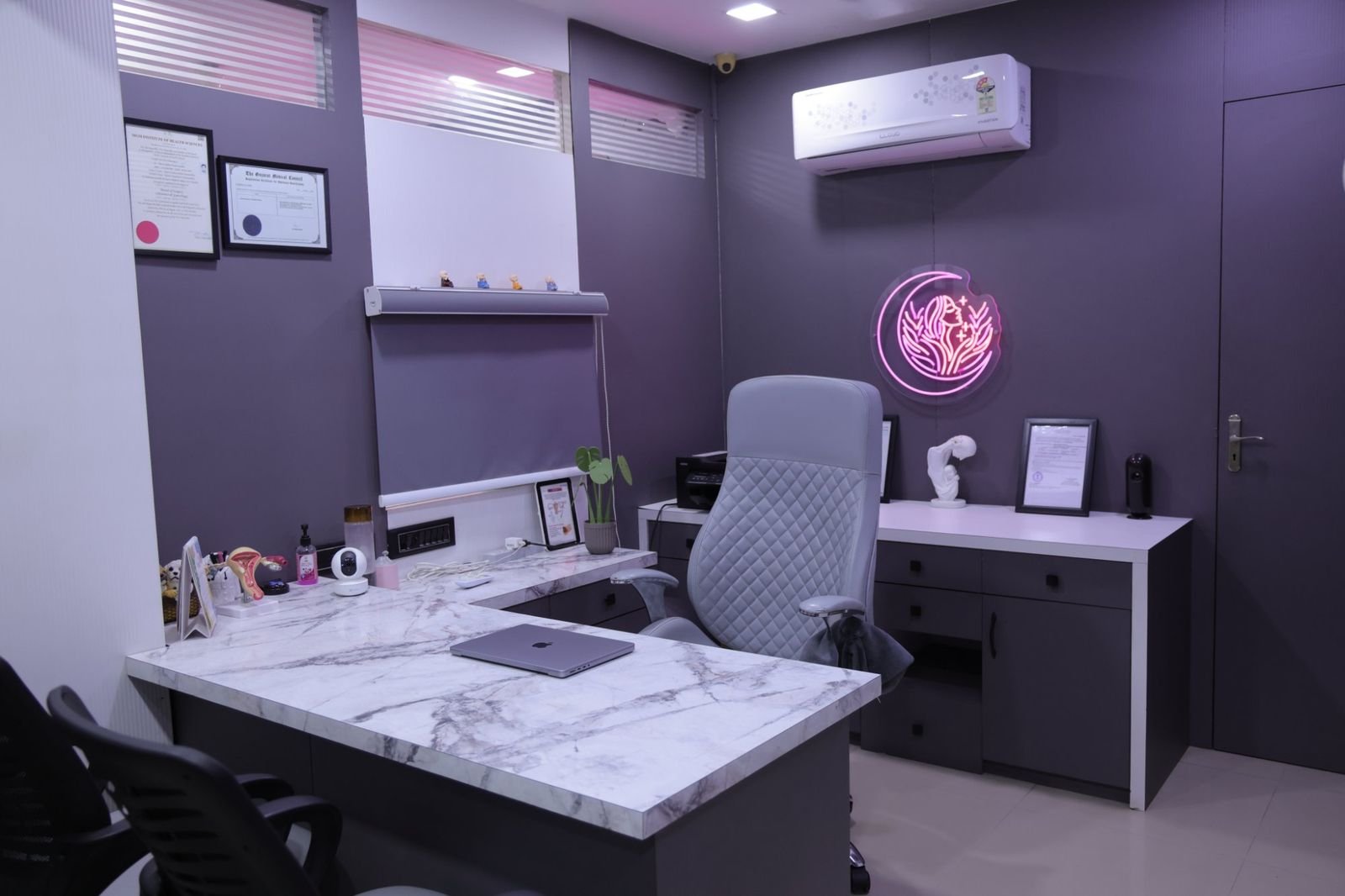
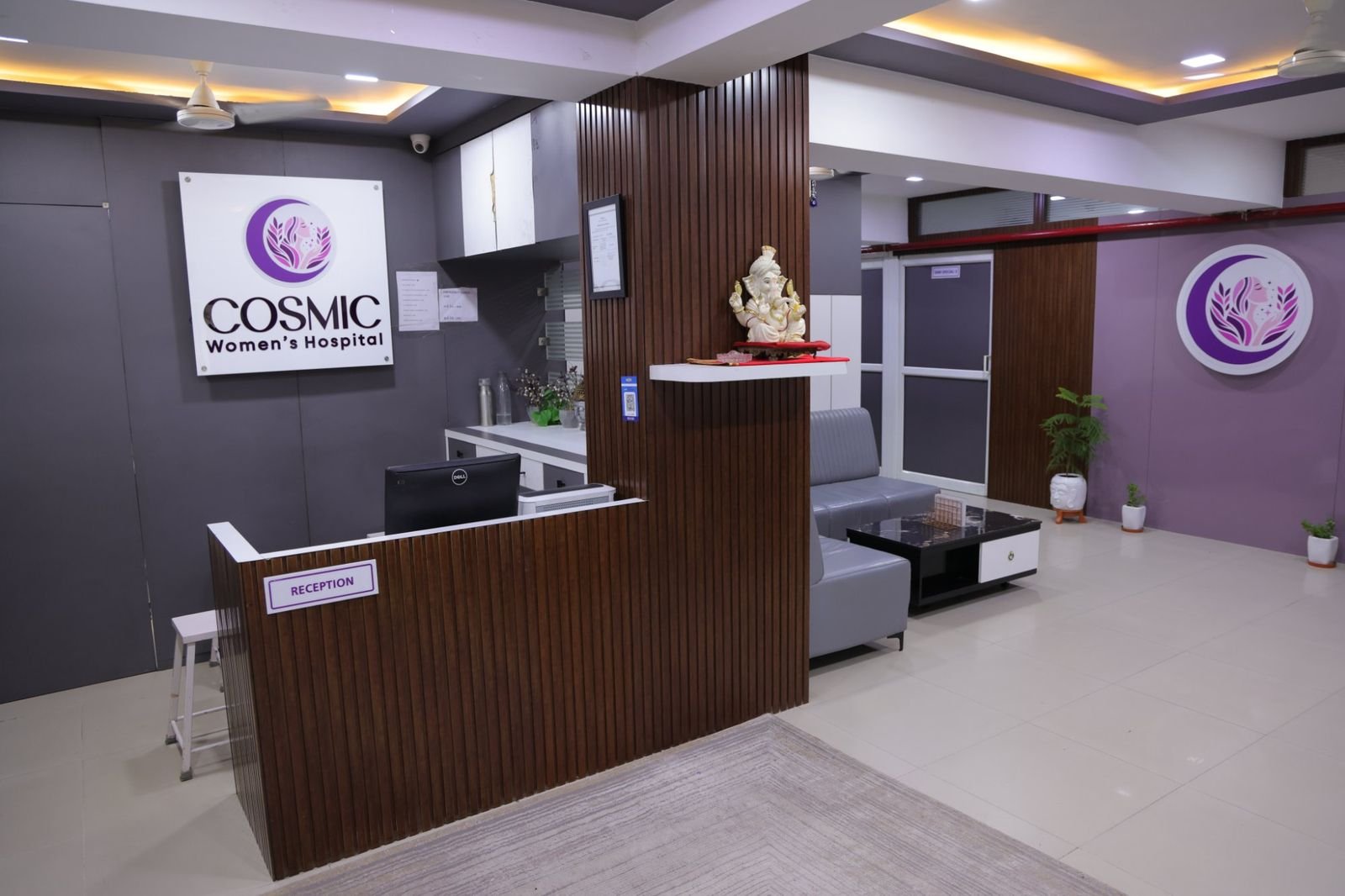
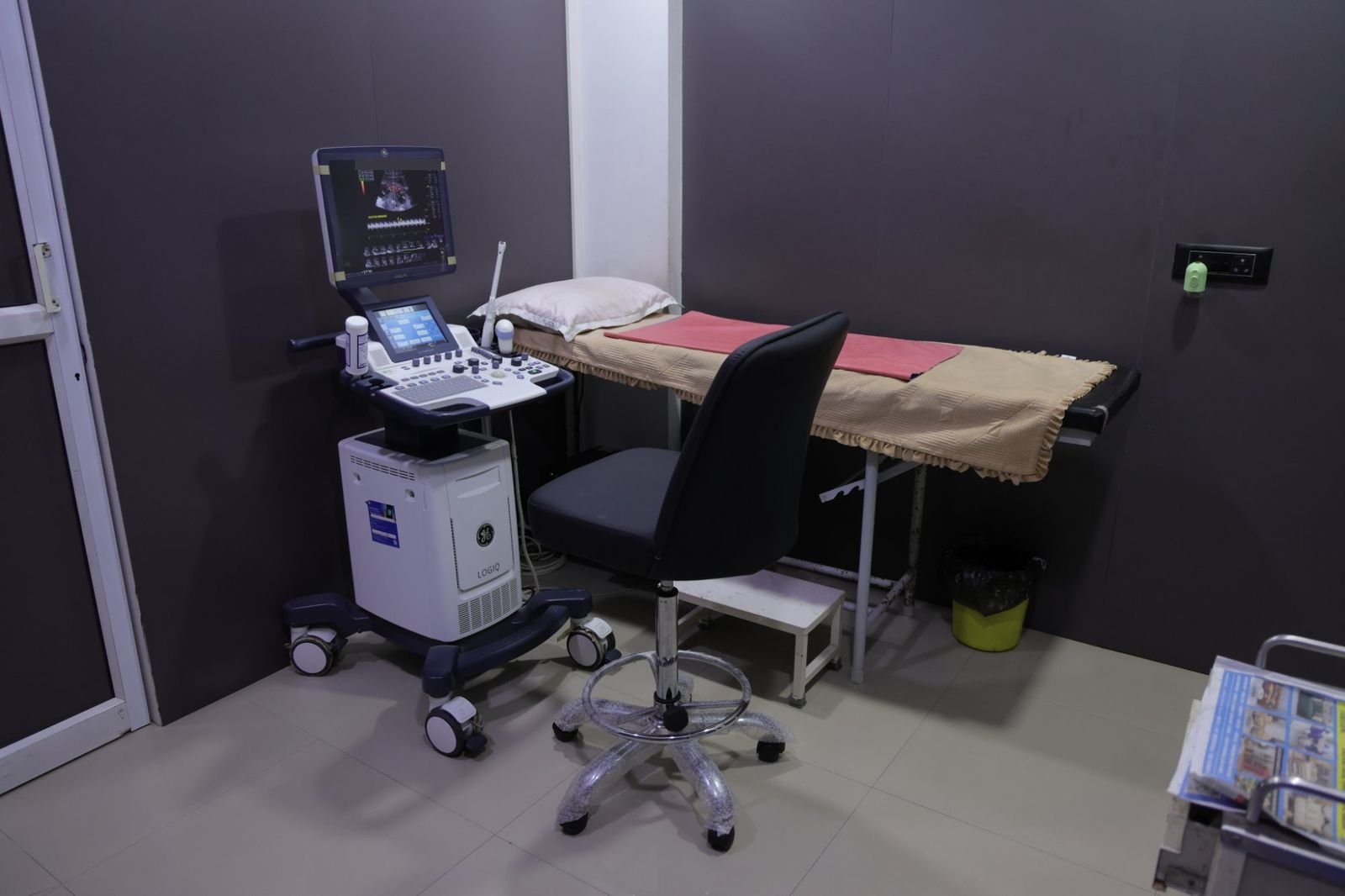
A trained female attendant stays with you at all times during any examination, and in the theatre and recovery area. You are welcome to bring a relative of your own as well.
What it costs
Consultation and scan charges are fixed and published. Surgery is not a single number, because it depends on the operation, the anaesthesia, the length of stay and the implants or consumables used — so we give you a written estimate before anything is booked, and we tell you what is likely to be covered if you have insurance or a government scheme.
| Item | Charge |
|---|---|
| New consultation — general gynaecology | Rs 500 |
| New consultation — infertility | Rs 1,000 |
| Follow-up consultation | Rs 300 |
| Pelvic or obstetric ultrasound | Rs 1,200 |
| Colour Doppler | Rs 1,500 |
| Laparoscopic or hysteroscopic surgery | Written estimate given before booking |
Coming to see us about an operation
Bring whatever you already have — previous scan reports and films, discharge summaries from any earlier operation, biopsy reports, and the medicines you are taking. If a scan is more than three months old we will usually repeat it here, because a fibroid map and an ovarian cyst both change.
The consultation is the point at which the decision is made, and it is made with you: what the problem is, whether it needs operating at all, which route, what it will cost, how long you will be off work, and what it means for pregnancy afterwards if that matters to you. If it is general gynaecology rather than surgery you need, the gynaecologist in Naroda page covers the routine services and the OPD.
Naroda, Ahmedabad · OPD Monday to Saturday, 10 am to 8 pm · Sunday emergency only
Emergency obstetric cover 24 hours · Telephone 77-9383-9383
Questions we are asked
Will I have a scar?
Three or four marks of 5 to 10 millimetres, one of them hidden in the navel. After a year most women have to look for them.
Can every operation be done by keyhole?
No, and a surgeon who says otherwise is overselling. A very large uterus, dense adhesions from previous surgery, a suspected cancer, or an unstable patient can all make open surgery the safer choice. Occasionally that decision is taken during the operation itself, which is why it is written into the consent beforehand.
Can I have a baby after a myomectomy?
Usually yes, and for fibroids inside the cavity removing them improves the chance of conceiving. There is a waiting period before trying, and if the uterine wall was opened deeply, the delivery is planned with that in mind. Both are discussed at your follow-up with the operation notes in front of us.
Do I need to be admitted the night before?
For most laparoscopic cases, admission is on the morning of surgery after an overnight fast. Hysteroscopic day-care procedures are morning in, evening out.
Is a second opinion a problem?
No. If you want to take the scan report and the estimate to another surgeon before deciding, that is a reasonable thing to do and we will give you everything you need to do it.
- Chen I, Kives S, Randle E, et al. Guideline No. 461: The Management of Uterine Fibroids. Journal of Obstetrics and Gynaecology Canada 2025;47(8):102970.
- Pritts EA, Vanness DJ, Berek JS, et al. The prevalence of occult leiomyosarcoma at surgery for presumed uterine fibroids. Gynecological Surgery 2015;12(3):165–177.
- American College of Obstetricians and Gynecologists. Committee Opinion No. 810: Robot-Assisted Surgery for Noncancerous Gynecologic Conditions. 2020.
- National Institute for Health and Care Excellence. NG88: Heavy menstrual bleeding — assessment and management.
- International Institute for Population Sciences. National Family Health Survey (NFHS-5), 2019–21, India Report.
Further reading
- Ovarian cysts: which ones need surgery, and which ones do not
- Fibroids: when they need treating, and when they do not
- Laparoscopic Gynaecological Surgery: When Keyhole Is the Right Operation
- Robotic or Laparoscopic Gynaecological Surgery: How the Choice Is Made
- Endometriosis: Symptoms, Diagnosis and What Treatment Actually Achieves