
Women's health
Cervical Cancer Screening: Pap Smear, HPV Test and the HPV Vaccine
When to start cervical screening, Pap smear vs HPV test, how often to repeat, and the HPV vaccine. Pap smear, colposcopy and HPV vaccination in Naroda, Ahmedabad.
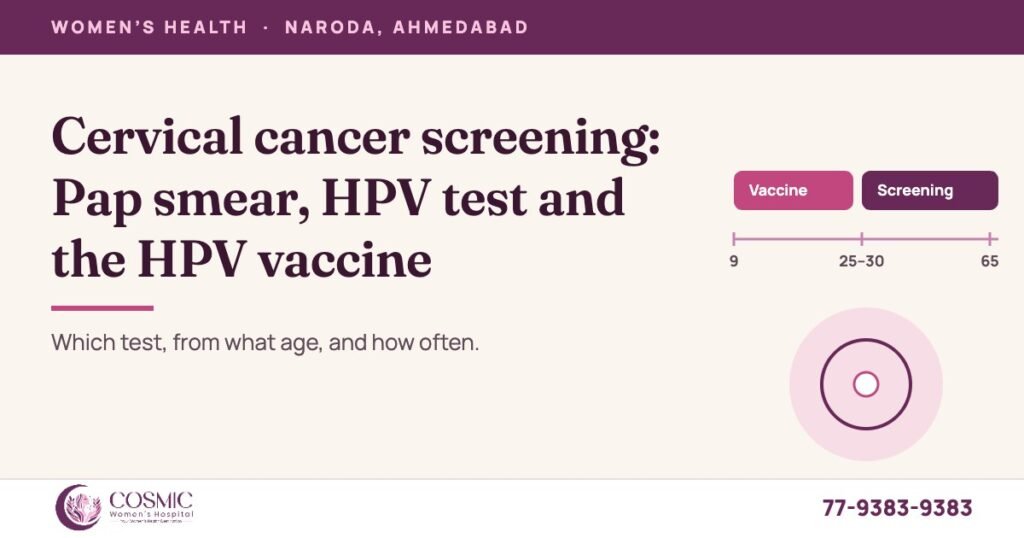
Almost every cervical cancer begins as an infection the body would normally clear on its own, and between that infection and a cancer there is usually a long, quiet window in which an abnormal area can be found and treated while it is still only a pre-cancer. Screening exists to use that window. This page sets out which test to have, at what age, how often to repeat it, and what happens if a result is abnormal.
Why screening works for this cancer in particular
India carries close to a quarter of the world’s cervical cancer. The FOGSI–ICOG recommendations put the Indian figures at 123,907 new cases and 77,348 deaths in 2020, against roughly 604,000 cases worldwide that year. It remains one of the commonest cancers in Indian women, and one of the very few that a simple outpatient test can prevent rather than merely detect early.
The reason is the natural history of the human papillomavirus. Most HPV infections cause no symptoms and go away without treatment — the recommendations estimate that 70–90% clear spontaneously within one to two years. Only a persistent infection with a high-risk type slowly turns cervical cells into a pre-cancer, and only some pre-cancers become invasive cancer. A positive HPV test is therefore not a diagnosis of cancer, and usually not a diagnosis of disease at all. It is a signal that this cervix needs watching.
The three tests, and what each one is good at
Three tests are in routine use in India, and they do not do the same job. A Pap smear (cytology) looks at the cells themselves for changes that have already begun. An HPV DNA test looks for the virus that causes those changes, so it reads a step earlier. VIA — visual inspection after painting the cervix with dilute acetic acid — needs no laboratory at all, which is why it is the test India’s national programme is built on.
| Test | What it looks for | Sensitivity | Specificity | Repeat interval |
|---|---|---|---|---|
| HPV DNA (validated PCR test) | High-risk types of HPV, before any cell changes | 94% | 88% | Every 5–10 years |
| Pap smear (cytology) | Abnormal cervical cells | 62.5–72.9% | 90.3–96.6% | Every 3 years |
| VIA (acetic acid) | Acetowhite areas on the cervix, seen with the naked eye | 74.2–79.4% | 85.2–85.8% | Every 3–5 years |
Test accuracy and intervals from the FOGSI–ICOG Good Clinical Practice Recommendations, 2024 (Tables 4 and 5). These are overall published figures from the guideline, not this centre’s own audit.
When to start, how often, and when it can stop
The universal recommendation is to begin cervical screening at 30 years, and at 25 where resources allow. Screening can stop at 65, but only on a condition that is easy to miss: there must be three consecutive negative cytology results, or two consecutive negative HPV tests within the last ten years, with the most recent test inside five years. A woman who has simply never been screened does not become exempt by turning 65.
| Situation | What the recommendations say |
|---|---|
| Starting age | 30 years universally; 25 years in better-resourced settings |
| Routine repeat | HPV test every 5–10 years, or Pap smear every 3 years, or VIA every 3–5 years |
| Stopping at 65 | Only after 3 negative cytology results, or 2 negative HPV tests within 10 years, the latest within 5 years |
| After hysterectomy with the cervix removed | Screening not needed — unless the surgery was for cancer or pre-cancer, when it continues |
| Immunocompromised women, including women living with HIV | Start at 25, screen more often, interval not to exceed 3 years; HPV testing preferred |
| Already vaccinated against HPV | Screening continues as normal — the vaccines do not cover every high-risk type |
FOGSI–ICOG Good Clinical Practice Recommendations, 2024, Table 5 and p. 5.
India’s public programme sits at the simpler end of that range. The Government of India’s Operational Framework: Management of Common Cancers provides for VIA once every five years for women aged 30 to 65, done by trained ANMs and staff nurses, with VIA-positive women referred on for evaluation. A health technology assessment for the Department of Health Research reached the same conclusion nationally, and in its model, screening reduced cervical cancer deaths by 28% to 70% compared with no screening at all.
The HPV vaccine: who it is for, and how many doses
Vaccination and screening are not alternatives. The vaccine prevents infection with the types it covers, which is why it works best before any exposure; screening catches what it does not cover. Girls aged 9 to 14 are the primary target group, and coverage above 80% in girls also lowers risk in boys.
| Age group | Standard schedule | Reduced-dose option (WHO) |
|---|---|---|
| Girls 9–14 years | 2 doses, at least 6 months apart | 1 or 2 doses |
| 15–20 years | 3 doses at 0, 1–2 and 6 months | 1 or 2 doses |
| 21 years and above | 3 doses at 0, 1–2 and 6 months (up to 45 years) | 2 doses, 6 months apart |
| Boys 9–14 / 15–26 years | 2 doses at 0 and 6 months / 3 doses at 0, 2 and 6 months | — |
| Immunocompromised, including people living with HIV | At least 2 doses; 3 where possible | — |
Standard schedules: FOGSI–ICOG recommendations, 2024, Table 1; reduced-dose schedules: WHO, December 2022, recorded by FOGSI as awaiting Drug Controller General of India approval. Licensed in India: Cervarix bivalent (10–45 years), Gardasil quadrivalent and nonavalent (9–45 years), Cervavac quadrivalent (girls and boys, 9–26 years).
If a screening test is abnormal
An abnormal screening test is not a diagnosis; it is an instruction to look more closely. The guideline pathway is colposcopy, with a biopsy where the colposcopist sees something that needs one. CIN1 is usually not treated — it is re-screened after one to two years, because most CIN1 regresses on its own. CIN2 or worse is treated, either by ablation (thermal ablation or cryotherapy) where the whole abnormal area is visible and there is no suspicion of invasion, or by excision — LLETZ/LEEP or a cone biopsy — where it is not. A follow-up HPV test at one year is the preferred check afterwards, and treatment is meant to happen within six months of the decision to treat.
Which of those steps applies depends on the result, the woman’s age, her plans for pregnancy and what the colposcopy shows — a conversation to have with the report in front of you.
At Cosmic
- Cervical screening, including Pap smear, is part of the routine gynaecology OPD at Cosmic Women’s Hospital & IVF Center, Naroda — it does not need a separate appointment type. General consultation is ₹500, follow-up ₹300.
- A female attendant stays with the patient throughout the examination.
- An HPV DNA test can be done at the same visit: the sample is taken here and sent to a laboratory for testing.
- Colposcopy and thermal ablation are done here at Cosmic.
- The HPV vaccine is given here — both Cervavac and Gardasil are available.
- Both consultants see women for screening: Dr. Rahul Khatri (MBBS, MS & DNB Obgy, FMAS) and Dr. Bhargavi Khatri (MBBS, MS Obgy, Gold Medalist, FRM). If you would prefer a woman doctor, ask for Dr. Bhargavi Khatri’s session when you book.
- OPD hours are 10 am to 8 pm, Monday to Saturday. Call 77-9383-9383 or book online.
- Bring your last menstrual period dates and any previous smear or HPV reports — a new result is far easier to interpret against the previous one.
Related reading: your first visit to a gynaecologist, five signs not to wait on, and menopause symptoms — screening continues through and after menopause. Everything treated here is listed on the gynaecologist in Naroda page.
Sources
- FOGSI–ICOG Good Clinical Practice Recommendations: Prevention and Management of Cervical Cancer. Gynaecologic Oncology Committee, Federation of Obstetric and Gynaecological Societies of India and Indian College of Obstetricians and Gynaecologists, 2024. fogsi.org/wp-content/uploads/2024/06/GCPR-Cervical-Cancer-18th-June-2024.pdf
- World Health Organization. WHO updates recommendations on HPV vaccination schedule. 20 December 2022. who.int/news/item/20-12-2022-who-updates-recommendations-on-hpv-vaccination-schedule
- Ministry of Health and Family Welfare, Government of India. Operational Framework: Management of Common Cancers, 2016. platform.who.int (policy documents, operational guidance)
- Health Technology Assessment for Cervical Cancer Screening in India. HTAIn, Department of Health Research, Ministry of Health and Family Welfare, with PGIMER Chandigarh. htain.dhr.gov.in
Where this is treated
More on women's health
 Women's healthVaginal discharge: what is normal, what is not, and what to do about itWhite or vaginal discharge in Naroda, Ahmedabad: what is normal, how BV, thrush and trichomoniasis differ, and when to be seen. Consultation ₹500 · 77-9383-9383.2 November 2026
 Women's healthUrine Leakage in Women: Why It Happens and What Actually HelpsStress, urgency and mixed urine leakage explained — the three-day diary, the tests, the pelvic floor programme, and when surgery is considered. Naroda, Ahmedabad.30 October 2026
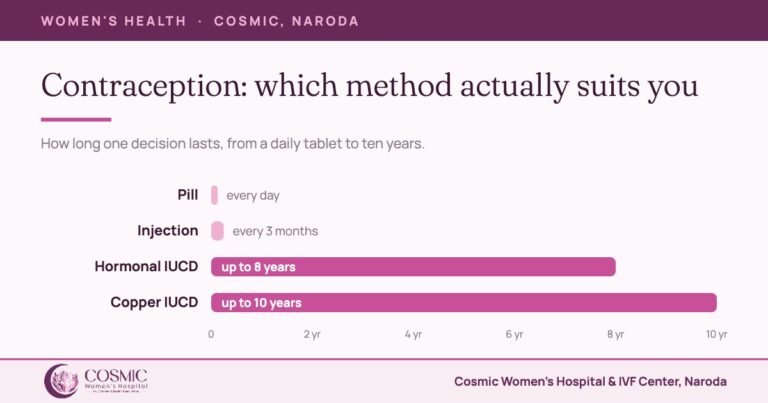 Women's healthContraception: Which Method Actually Suits YouHow contraceptive methods compare in real use — IUCDs, the injection, pills, condoms, the emergency pill and sterilisation. Gynaecology OPD Mon to Sat, Naroda.16 October 2026