Menopause is one date on the calendar, but the years around it change periods, sleep, joints, mood and the bladder — here is what is worth treating, what the evidence actually supports, and what needs a check sooner rather than later.
Most women come to the OPD in their mid-forties not asking about menopause but about something else — periods that have turned unpredictable, knees and shoulders that ache in the morning, sleep that breaks at three o’clock. Menopause itself is one point in time. The years on either side of it are what women live through, and most of what troubles them in those years can be treated.
What the words actually mean
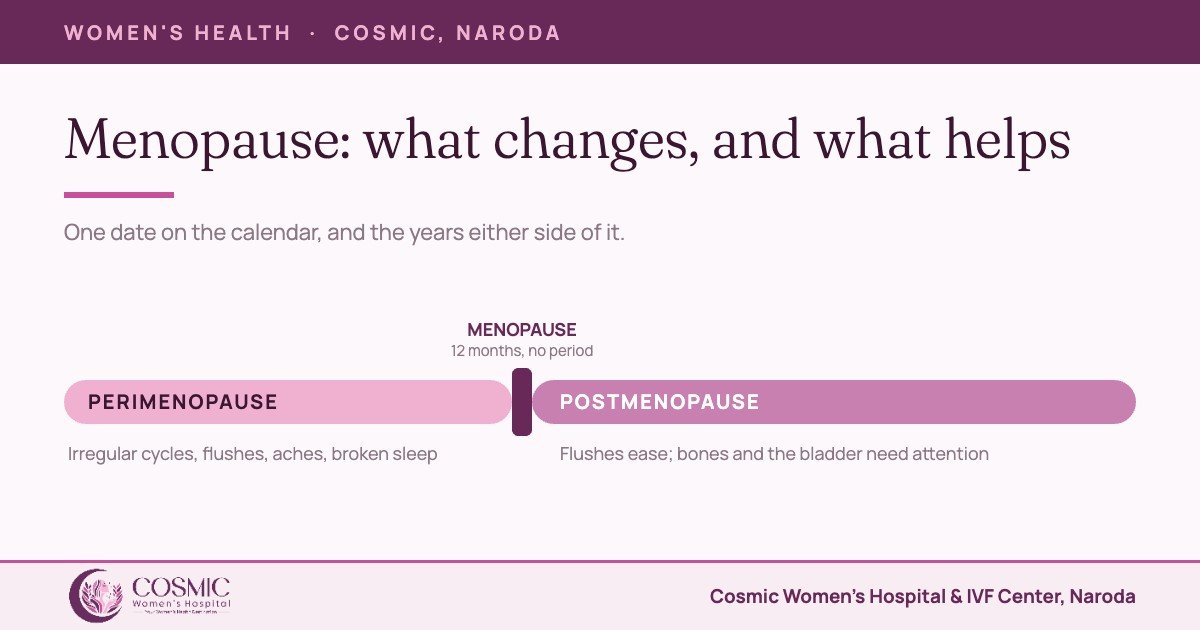
Menopause is a diagnosis made looking backwards. The World Health Organization describes natural menopause as confirmed after 12 consecutive months without a period, with no other obvious cause, and places it generally between 45 and 55 years of age.
In India it arrives earlier. A 2024 analysis of the National Family Health Survey and the Longitudinal Ageing Study in India put the average menopausal age at about 46 years, from roughly 44 in Bihar to 47.6 in Kerala. A woman of 44 whose periods have stopped is not unusual here, and not “too young” to be believed.
| Term | What it means |
|---|---|
| Perimenopause | The transition. Periods become irregular and symptoms begin, often several years before the last period. |
| Menopause | Twelve consecutive months with no period, no other cause. |
| Postmenopause | Everything after that point. |
| Premature menopause | Periods stop before the age of 40. It needs assessment, not reassurance. |
| Surgical menopause | Both ovaries removed, so the change is immediate rather than gradual. |
What changes, and for how long
Hot flushes and night sweats occur in up to 80% of women, and last longer than most people expect: the Menopause Society’s 2023 review puts their mean duration at seven to nine years, and in about a third of women more than ten. “Wait it out” is not a plan for someone whose sleep breaks every night.
But the hot-flush stereotype describes Indian clinics poorly. In a community study of 401 women aged 40 to 50 in urban Mumbai, muscle and joint pains were the commonest complaint at 65%, while hot flushes and sweating were reported by only 12.5%. That is one city, not a national figure — but it matches what comes through the door, and it is why aching joints in a woman of 46 deserve to be taken seriously rather than treated as unrelated.
Does it need a blood test?
Usually not. Over 45 it is a clinical diagnosis, made from the pattern of periods and symptoms. A single FSH or oestradiol level in the perimenopause can mislead, because the hormones swing from week to week; the UK Faculty of Sexual and Reproductive Healthcare advises going by symptoms rather than FSH unless premature menopause is a concern. A hormone test earns its place when periods stop before 40, when the picture is unclear in the early forties, or when a hormonal contraceptive masks the pattern. Worth checking instead: haemoglobin, thyroid function, blood sugar and lipids — anaemia and thyroid disease imitate menopause closely and both are common here.
What helps hot flushes and night sweats
This is where the most money is wasted. The Menopause Society reviewed the non-hormonal options in 2023 and separated them clearly.
| Supported by the evidence | Not recommended for hot flushes |
|---|---|
| Cognitive behavioural therapy; clinical hypnosis | Over-the-counter supplements and herbal remedies |
| Certain antidepressants (SSRIs and SNRIs), prescribed for this purpose | Soy foods, soy extracts and equol |
| Gabapentin; oxybutynin | Black cohosh; acupuncture; cannabinoids |
| Fezolinetant, a newer non-hormonal drug | Paced breathing; cooling techniques; trigger avoidance |
| Weight loss, where weight is high | Yoga, exercise and mindfulness as a treatment for flushes |
That last line needs care. Exercise and yoga were not found to reduce hot flushes — a narrow verdict on one symptom. They remain among the most useful things a woman in her forties can do for her bones, blood pressure, blood sugar, sleep and mood, and nothing here argues against them. What the review does argue against is paying for supplements marketed for menopause.
Hormone therapy: who it suits, and who it does not
Hormone therapy remains the most effective treatment for hot flushes and night sweats. The Menopause Society’s position is that for most healthy women with symptoms who are under 60 and within ten years of their menopause, the benefits outweigh the risks; the British Menopause Society adds that it is first-line for preventing osteoporosis in symptomatic women under 60. The decision is individual, and the conversation covers three things.
- Route and type matter. Transdermal oestradiol — a patch or gel — is unlikely to raise the risk of clot or stroke the way oral oestrogen can, and micronised progesterone appears kinder than older progestogens. A woman who still has her uterus needs a progestogen alongside oestrogen; a 52 mg hormonal IUCD can do that and handle heavy perimenopausal bleeding at the same time.
- Breast cancer is the question everyone asks. Oestrogen alone shows little or no change in risk. Combined therapy carries a small risk that depends on duration and on the progestogen used — low in context, the British Menopause Society says, smaller than the effect of obesity or regular alcohol. A past breast cancer is a contraindication to systemic therapy, and that discussion belongs with the treating oncologist.
- There is no fixed stopping date. Arbitrary limits on duration are not supported, and treatment need not stop at 60 or 65 for the birthday alone. It is reviewed at least once a year.
Two points that get missed: hormone therapy is not contraception — pregnancy in the perimenopause is uncommon but real, and contraception can be stopped at 55 — and compounded “bioidentical” hormones made up by a pharmacy are not better than licensed ones, only untested.
Vaginal dryness and urinary symptoms are a separate problem
Dryness, soreness, pain with intercourse and recurrent urinary symptoms form a different group — the genitourinary syndrome of menopause — and behave differently. Flushes fade with time; these do not, and without treatment they are generally progressive. They affect a large share of postmenopausal women, and most never mention them, because nobody asks.
Treatment is usually local and straightforward. Lubricants for intercourse and a regular vaginal moisturiser come first. Where that is not enough, low-dose vaginal oestrogen is effective, is only minimally absorbed into the bloodstream, does not need a progestogen alongside it and is not associated with an increased risk of breast cancer. It usually has to be continued, because symptoms return when it stops. Laser and other energy-based devices sold for this have not been shown to work in properly controlled trials.
Bones, heart and the checks that matter after 45
Bone loss speeds up around the menopause, and Indian women start from a lower base. In a community study of 150 postmenopausal women aged 50 and over in semi-urban Tamil Nadu, osteoporosis was present at some site in about half, and half had vitamin D insufficiency or deficiency. Those are research figures from one region, not a measure of any clinic’s own patients, but the direction is consistent across Indian studies: calcium, vitamin D, weight-bearing activity and, where indicated, a bone density scan and treatment all earn their place.
The cardiovascular advantage women hold over men also narrows after menopause as oestrogen falls, which makes the mid-forties the point to start checking blood pressure, blood sugar and lipids at intervals rather than only when something hurts — alongside breast awareness and cervical screening.
Bleeding after menopause always needs a look
One rule matters more than anything else here: any bleeding after a full year without periods needs to be assessed — not watched, and not treated over the phone. So does bleeding between periods, bleeding after intercourse, or a sudden change to much heavier bleeding in the perimenopause. Most have a benign explanation — a polyp, a fibroid, a thin fragile lining, a hormonal cause. The rule exists for the minority that do not, and because assessment is quick: an examination, a pelvic ultrasound, and a hysteroscopy with a biopsy where the scan or the history calls for it. Our article on heavy periods and what actually treats them covers that work-up, and fibroid treatment the commonest structural cause.
If it happens before 40
Periods stopping before 40 is premature ovarian insufficiency — a different situation, needing investigation rather than reassurance. The British Menopause Society position is that women with premature or early menopause should use hormone therapy at least until the average age of natural menopause, because those extra years without oestrogen affect bone and cardiovascular health as well as symptoms. Fertility questions there are best raised early.
At Cosmic
Menopause consultations run in the general gynaecology OPD with Dr. Rahul Khatri and Dr. Bhargavi Khatri, and a female attendant stays with the patient throughout any examination. Pelvic ultrasound is done in-house at Rs 1,200, blood samples for thyroid, sugar, lipids and haemoglobin are taken at the hospital, and hysteroscopy for abnormal bleeding is carried out here. Osteoporosis is treated in menopausal patients; a bone density scan or a mammogram, where indicated, is arranged with a nearby imaging centre. A hormonal IUCD can be fitted for perimenopausal bleeding and for endometrial protection alongside oestrogen. Consultation is Rs 500 for a new general gynaecology case, Rs 300 for a follow-up. OPD Monday to Saturday, 10 am to 8 pm; call 77-9383-9383. If this is a first appointment, what happens at a first visit explains what to bring.
Ultrasound and the law. Prenatal sex determination is not done at Cosmic Women’s Hospital and is prohibited by law under the Pre-conception and Pre-natal Diagnostic Techniques (Prohibition of Sex Selection) Act, 1994.
This article is general information about menopause and is not a substitute for individual medical advice. Treatment, including hormone therapy, depends on your own history, examination and reports, and should be decided in consultation with your doctor.
Sources
- World Health Organization. Menopause (fact sheet).
- Ghosh R, Syamala TS. Estimation of mean menopausal age and spatial variations of menopause in India: evidence from large scale surveys. GeoJournal 2024;89:244.
- Jadhav A, Bavaskar Y. An epidemiological study of the perimenopausal and menopausal health problems in women living in an urban area of Mumbai. Int J Community Med Public Health 2017;4(9):3088–3093.
- The 2023 nonhormone therapy position statement of The North American Menopause Society. Menopause 2023;30(6):573–590.
- The 2022 hormone therapy position statement of The North American Menopause Society. Menopause 2022;29(7):767–794.
- The 2020 genitourinary syndrome of menopause position statement of The North American Menopause Society. Menopause 2020;27(9):976–992.
- British Menopause Society and Women’s Health Concern. 2020 recommendations on hormone replacement therapy in menopausal women (consensus statement, revised 2025).
- Faculty of Sexual and Reproductive Healthcare. FSRH Guideline: Contraception for Women Aged Over 40 Years. 2017, amended 2023.
- Paul TV, Thomas N, Seshadri MS, et al. Prevalence of osteoporosis in ambulatory postmenopausal women from a semiurban region in southern India. Endocr Pract 2008;14(6):665–671.
Written by the clinical team at Cosmic Women’s Hospital & IVF Center, Naroda, Ahmedabad.
Medically reviewed by Dr. Rahul Khatri — MBBS, MS & DNB Obgy, FMAS. Consulting Obgyn, Laparoscopic and Robotic Surgeon, Director.
Reviewed 14 October 2026.
Thinking about a menopause consultation? Cosmic Women’s Hospital & IVF Center is at 3rd Floor, The Capital Corporate, Nr. Naroda Muktidham, Naroda, Ahmedabad 382330. Call 77-9383-9383 or see Cosmic Women’s Hospital to book an appointment.
Where this is treated
Book a consultation
Tell us how we can help and we will call you back.
Cosmic Women's Hospital
Cosmic Women’s Hospital & IVF Center is a registered Level 2 ART clinic in Naroda, Ahmedabad — obstetrics, gynaecological surgery, IVF and ICSI, with ultrasound in-house and 24-hour emergency obstetric cover. Articles here are written by the clinical team and medically reviewed by Dr. Rahul Khatri or Dr. Bhargavi Khatri before publication.