Heavy periods are a symptom with nine recognised causes — here is how the cause is found, why a normal scan does not close the question, and which treatments measurably reduce the bleeding.
Most women who come to the clinic about heavy periods have been managing them for years. They have changed the brand of pad, planned travel around the calendar, and been told at some point that heavy bleeding is simply what their body does. Often it is not. Heavy menstrual bleeding is a symptom, not a diagnosis, and in most women the cause can be identified in a single consultation and the bleeding reduced with treatment that does not begin with surgery.
What counts as a heavy period
There is no millilitre figure you need to measure. Both the UK National Institute for Health and Care Excellence and the International Federation of Gynecology and Obstetrics define heavy menstrual bleeding by its effect rather than its volume: “excessive menstrual blood loss which interferes with a woman’s physical, social, emotional and/or material quality of life.” FIGO’s 2018 revision sets the normal bounds of a period at a duration of eight days or less, with cycles arriving every 24 to 38 days, and defines flow only as bleeding heavy enough to interfere with daily life.
In practice, these are the things worth telling a gynaecologist about:
- Bleeding that soaks through clothing or bedding, or that needs protection changed every hour or two
- Periods lasting more than eight days, or cycles closer together than 24 days
- Passing clots, or needing double protection
- Planning work, travel or exams around the period
- Tiredness, breathlessness on stairs, or hair fall — the signs of iron deficiency rather than of the bleeding itself
- Bleeding between periods, after intercourse, or after the menopause — these are a different problem and need assessment on their own
Why it is worth treating sooner in India than the textbooks imply
The National Family Health Survey (NFHS-5, 2019–21) found 57% of Indian women aged 15 to 49 anaemic, up from 53% in the previous round. That baseline changes the arithmetic. A period that would be watched for a few more cycles in a population with normal iron stores is, here, usually sitting on top of an existing deficiency. The Ministry of Health’s Anemia Mukt Bharat guidelines grade anaemia in women as mild at a haemoglobin of 10 to 10.9 g/dl, moderate at 7 to 9.9, and severe below 7.
NICE recommends a full blood count for every woman with heavy menstrual bleeding, taken in parallel with starting treatment rather than before it — there is no reason to leave someone bleeding while a report is awaited. The July 2026 update to that guideline withdrew its earlier advice against routine ferritin testing, specifically because of the risk of iron deficiency in this group. Treating the bleeding and treating the iron are two separate jobs, and both get done.
Nine causes, and why a normal scan does not close the question
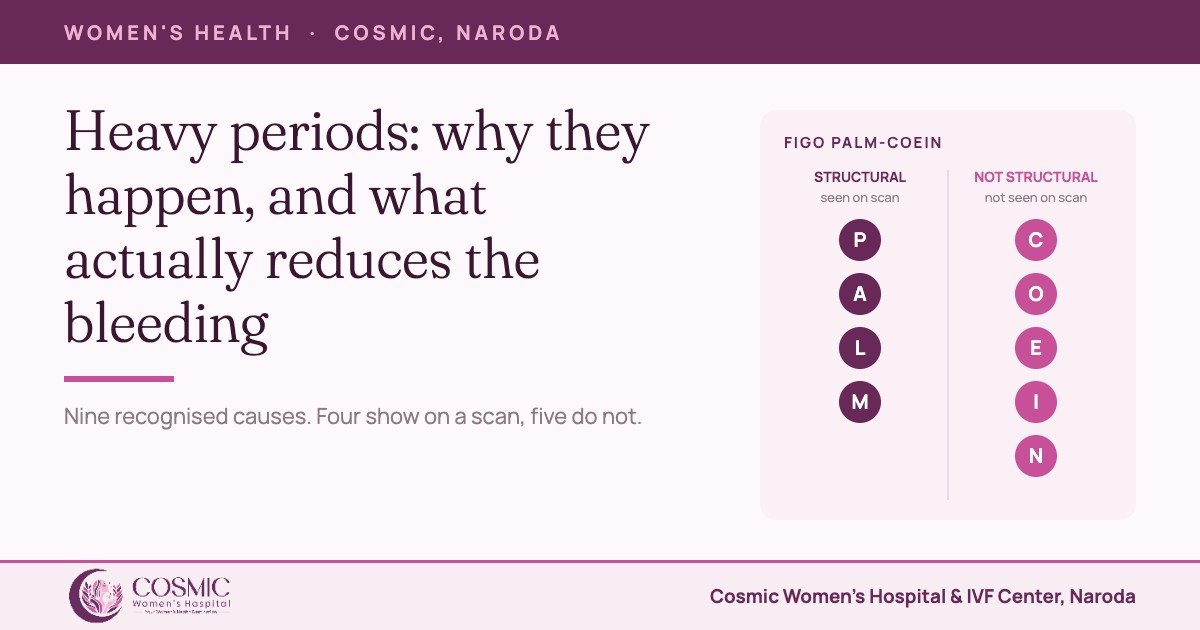
FIGO classifies the causes of abnormal uterine bleeding under the acronym PALM-COEIN. The first four are structural — they can be seen on a scan or at hysteroscopy. The last five are not visible on any image, which is the single most useful thing to understand about this condition.
Two of the non-structural causes matter especially often. A clotting disorder such as von Willebrand’s disease is worth testing for when the heavy bleeding has been there since the very first period, or where there is a personal or family history that points to it — easy bruising, bleeding after dental extraction, a relative with the same story. Ovulatory dysfunction is the other: cycles that are irregular as well as heavy, commonly with polycystic ovary syndrome behind them.
Two tests that are often done elsewhere are specifically not recommended as routine: NICE advises against female hormone profiles in heavy menstrual bleeding, and against thyroid testing unless there are other signs or symptoms of thyroid disease. Nor is a dilatation and curettage a diagnostic test for this problem.
What the assessment actually involves
A first consultation covers the pattern of bleeding, the symptoms around it, what it is costing you in ordinary life, and a full blood count. Beyond that, the investigation is chosen by what the history and examination suggest — not ordered as a standing panel.
| What is suspected | First-line investigation | Why |
|---|---|---|
| Bulky or tender uterus, significant period pain — possible adenomyosis | Transvaginal ultrasound | Preferred over transabdominal scanning or MRI for this question |
| Palpable uterus, suspected pelvic mass, or examination difficult | Pelvic ultrasound | Establishes size, site and number of fibroids |
| Bleeding between periods, suspected polyp or submucosal fibroid | Outpatient hysteroscopy | Ultrasound can miss a small cavity lesion that a scope sees directly |
| Bleeding since the first period, or a bleeding history in the family | Coagulation testing | Picks up von Willebrand’s disease and similar disorders |
| Irregular and heavy, obesity or PCOS, or treatment has failed | Endometrial biopsy at hysteroscopy | Taken under direct vision — blind biopsy is not recommended |
Hysteroscopy is done as an outpatient procedure using a vaginoscopic technique with a miniature scope of 3.5 mm or smaller, with oral pain relief beforehand, and where the service allows it the polyp or small submucosal fibroid is removed at the same sitting rather than at a second appointment. That “see and treat” arrangement is what makes the difference between one visit and three.
What it costs at Cosmic
| Item | Fee |
|---|---|
| Consultation, new general gynaecology case | Rs 500 |
| Follow-up consultation | Rs 300 |
| Pelvic (gynaecological) ultrasound | Rs 1,200 |
Blood tests, hysteroscopy and surgical procedures are quoted before anything is done.
PC&PNDT notice. Prenatal sex determination is not done at Cosmic Women’s Hospital and is prohibited by law under the Pre-conception and Pre-natal Diagnostic Techniques (Prohibition of Sex Selection) Act, 1994.
What actually reduces the bleeding
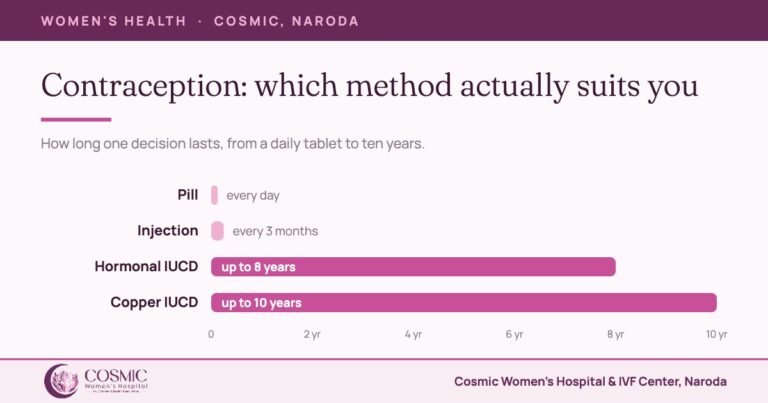
Where no structural cause is found, or where the cause is a fibroid under 3 cm or suspected adenomyosis, the recommended first treatment is a levonorgestrel-releasing intrauterine system — the hormonal IUCD. It is the treatment with the largest measured effect on blood loss, and it is fitted in the outpatient clinic.
Across those nine trials, 82% of women on the IUCD had treatment success against 43% on oral medication, and two years later 64% were still on it compared with 38% of women given tablets — the practical point being that a treatment only works for as long as someone is willing to keep taking it. Where the IUCD is declined or unsuitable, tranexamic acid, an anti-inflammatory such as mefenamic acid, a combined hormonal contraceptive, or cyclical oral progestogens are all reasonable, and tranexamic acid plus an anti-inflammatory can be continued for as long as they help.
A point worth raising at the consultation. If pregnancy is wanted soon, that changes the order of everything above — the IUCD and the pill are both contraceptives, and ablation is not an option at all. Say so at the first visit rather than at the third, so the plan is built around it.
When the fibroid is 3 cm or more
Size changes the approach. Below 3 cm, and where the cavity is not distorted, the medical ladder above applies unchanged. At 3 cm or more, the assessment moves to the fibroid itself — its size, site and number on ultrasound — and the options are discussed against that.
Submucosal fibroids up to 3 cm are removed hysteroscopically at Cosmic, through the cervix, with no incision. Larger and intramural fibroids are approached by laparoscopic myomectomy, which Dr. Rahul Khatri performs here; uterine artery embolisation is arranged as a referral to an interventional radiology service, because it needs an angiography suite. Robot-assisted cases are operated at Apollo Hospital, Gandhinagar, where he is attached — there is no surgical robot at Cosmic. There is more detail on each of these in our article on fibroid treatment.
A few figures worth knowing from the 2025 fibroid management guideline: a GnRH agonist can shrink a fibroid by up to half in three months, but regrowth begins within about 12 weeks of stopping, so it is a bridge to surgery rather than a treatment in itself. Myomectomy improves symptoms in up to 80% of women, although new fibroids are visible on imaging in 50–60% within five years. Embolisation is technically successful in 95–97% of cases, with a 32% chance of needing a further procedure within five years against 2% after surgery. And because a fibroid very occasionally turns out not to be one — an unexpected leiomyosarcoma is found in roughly 1 in 2,000 operations for presumed fibroids — every specimen removed here goes for histopathology.
If bleeding does not settle
Where medication has been tried and has not worked, or the bleeding is severe enough that waiting is not reasonable, the two definitive options are second-generation endometrial ablation and hysterectomy. Ablation treats the lining and is not compatible with a future pregnancy. For hysterectomy, the route — laparoscopic, vaginal or open — is chosen for the individual uterus and the woman’s own preference, as is the question of total or subtotal surgery. Ovaries are removed only where that is the woman’s express wish, after a discussion of what losing them means at her age. A dilatation and curettage is not a treatment for heavy periods and is not offered as one.
Adenomyosis and endometriosis often sit behind heavy, painful periods together, and the hormonal IUCD is a first-line treatment for both — our page on endometriosis treatment covers that overlap. A normal pelvic examination and a normal scan do not exclude either.
At Cosmic. Heavy periods are assessed in the general gynaecology OPD, Monday to Saturday, 10 am to 8 pm. The consultation, ultrasound and blood sampling are all done in-house on the same visit, and treatment usually starts that day rather than after the reports. Hormonal IUCD fitting and outpatient hysteroscopy are done here; Dr. Rahul Khatri takes the laparoscopic and hysteroscopic surgery, and Dr. Bhargavi Khatri leads fertility care for women whose heavy bleeding sits alongside difficulty conceiving. If you would prefer to be seen by a woman doctor, ask for her session when you book.
Cosmic Women’s Hospital & IVF Center — 3rd Floor, The Capital Corporate, Nr. Naroda Muktidham, Naroda, Ahmedabad 382330.
OPD Monday to Saturday, 10 am to 8 pm. To book, call 77-9383-9383 or see our page for a gynaecologist in Naroda. New to the clinic? Read what happens at a first visit.
Sources
- National Institute for Health and Care Excellence. Heavy menstrual bleeding: assessment and management. NICE guideline NG88, 2018, updated 2026.
- Munro MG, Critchley HOD, Fraser IS; FIGO Menstrual Disorders Committee. The two FIGO systems for normal and abnormal uterine bleeding symptoms and classification of causes of abnormal uterine bleeding in the reproductive years: 2018 revisions. Int J Gynecol Obstet 2018. doi:10.1002/ijgo.12666
- International Institute for Population Sciences. National Family Health Survey (NFHS-5), 2019–21: India Report. Anaemia in women aged 15–49.
- Ministry of Health and Family Welfare, Government of India. Anemia Mukt Bharat: Operational Guidelines, 2018. Grades of anaemia.
- Potter J, Lindblad AJ. How to slow the flow II: levonorgestrel intrauterine systems for heavy menstrual bleeding. Tools for Practice #323. College of Family Physicians of Canada, 2022.
- Potter J, Young J. How to slow the flow III: tranexamic acid for heavy menstrual bleeding. Tools for Practice #348. College of Family Physicians of Canada, 2023.
- Chen I, Kives S, Randle E, Rattray D, Sanders A, Vilos G. Guideline No. 461: the management of uterine fibroids. J Obstet Gynaecol Can 2025;47(8):102970.
- Pritts EA, Vanness DJ, Berek JS, et al. The prevalence of occult leiomyosarcoma at surgery for presumed uterine fibroids. Gynecol Surg 2015;12(3):165–177.
Treatment effect figures quoted above are averages from published randomised trials and systematic reviews, not audited results from this centre. This article is general information about a common condition and is not a substitute for a consultation; which treatment suits you depends on your examination, scan and reports.
Written by the clinical team at Cosmic Women’s Hospital & IVF Center, Naroda, Ahmedabad.
Medically reviewed by Dr. Bhargavi Khatri — MBBS, MS Obgy (Gold Medalist), FRM. Consulting Obgyn, Infertility & IVF Specialist.
Reviewed on 12 October 2026.
Where this is treated
Book a consultation
Tell us how we can help and we will call you back.

Cosmic Women's Hospital
Cosmic Women’s Hospital & IVF Center is a registered Level 2 ART clinic in Naroda, Ahmedabad — obstetrics, gynaecological surgery, IVF and ICSI, with ultrasound in-house and 24-hour emergency obstetric cover. Articles here are written by the clinical team and medically reviewed by Dr. Rahul Khatri or Dr. Bhargavi Khatri before publication.