What happens at a first antenatal visit at Cosmic Women’s Hospital in Naroda — the history, the dating scan, the blood tests, how your due date is fixed, and how often you will be seen after it.
A home urine test has told you that you are pregnant. It has not told you how many weeks you are, whether the pregnancy is sitting in the right place, or whether anything about your own health needs attention before the pregnancy gets further along. That is what a first antenatal visit is for, and the first three months are the only part of pregnancy where some of those questions can still be answered properly.
When to come, and why the first twelve weeks are not interchangeable
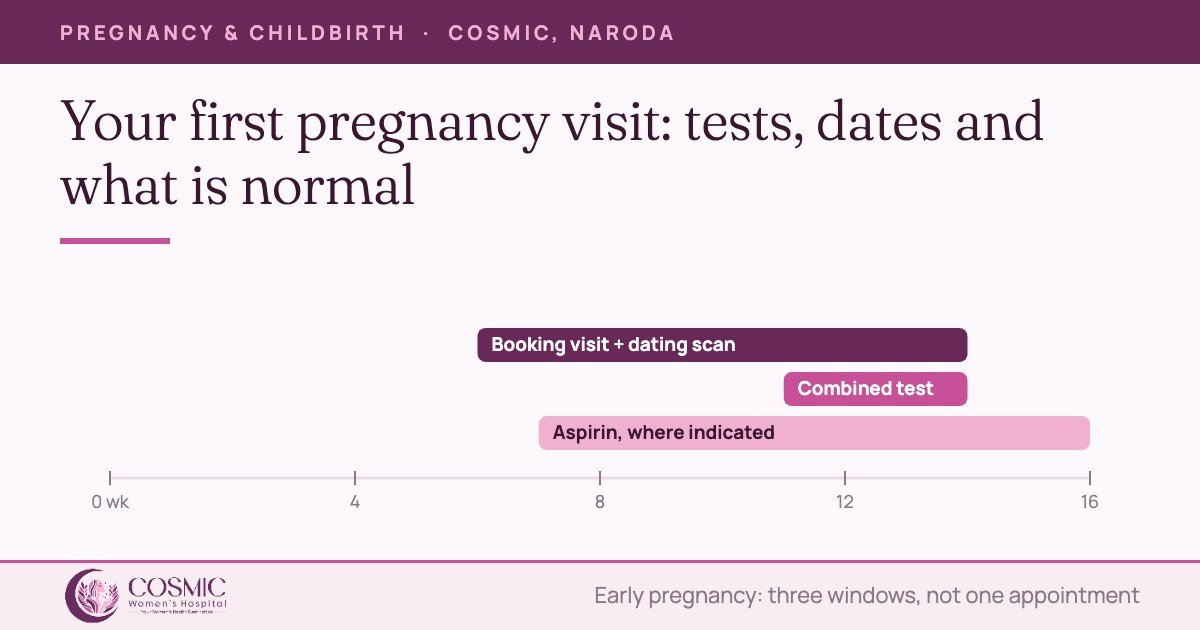
The World Health Organization recommends a first antenatal contact within the first 12 weeks of pregnancy, and India’s own antenatal guidelines ask for registration “within 12 weeks — preferably as soon as pregnancy is suspected”. The reason is not paperwork. Three separate things in early pregnancy have a window that closes, and all three of them are easier to arrange if you come at six to eight weeks than at thirteen.
What actually happens in the room
The history
The longest part of a first visit is talking, not testing. The date your last period started and how regular your cycles are; whether this pregnancy followed fertility treatment; every previous pregnancy, including miscarriages and terminations, and how each one ended; previous caesarean sections and any other abdominal or uterine surgery; blood pressure, thyroid, diabetes, thalassaemia trait, epilepsy or heart disease in you or in the family; every tablet and supplement you are currently taking. Bring your old papers if you have them — a previous discharge summary or operation note changes more decisions than anything else in the file.
The examination
Weight and height, blood pressure, pulse, a look for pallor, a thyroid and breast examination, and an abdominal examination. An internal examination is not routine in early pregnancy and is done only where there is a reason for it, such as bleeding or pain. If you have never had a gynaecological examination before, our article on your first visit to a gynaecologist describes it step by step.
The scan
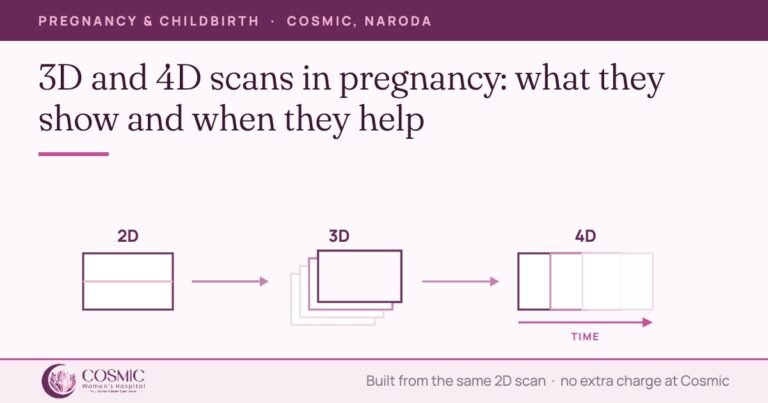
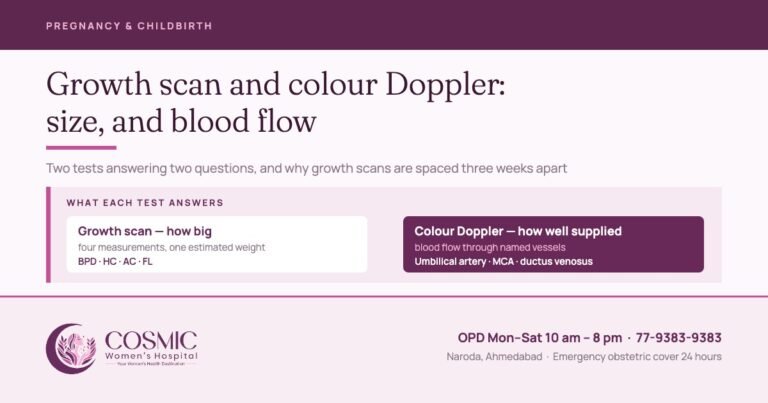
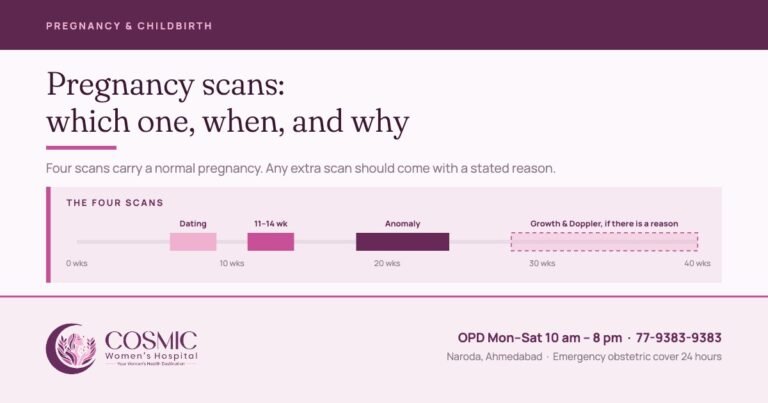
An ultrasound at the first visit confirms that the pregnancy is inside the uterus, that there is a heartbeat, whether there is one baby or more, and — most importantly — how many weeks pregnant you actually are. WHO recommends one scan before 24 weeks for exactly these reasons. What follows later in the pregnancy is set out in our guide to the scans in pregnancy and when each one is done.
How your due date is fixed, and why it is not revised later
Between 11 and 14 weeks, when the baby measures 45 to 84 mm from crown to rump, that single measurement dates the pregnancy to within five days either way in 95 per cent of cases, according to the ISUOG first-trimester guideline. Above 84 mm the crown-rump length stops being reliable and head circumference takes over, and by the third trimester a scan can estimate a baby’s weight but can no longer tell you when it was conceived. If the pregnancy came from IVF, the date of conception is already known and is used instead of any measurement.
This is why a date set early is not changed afterwards, even when a later scan suggests a bigger or smaller baby. A late scan that disagrees with an early one is telling you about growth, not about dates.
The blood and urine tests, and what each one changes
India’s antenatal guidelines set out the routine panel, and it is short because every test on it changes something that can be acted on.
| Test | What it is looking for | What changes if it is abnormal |
|---|---|---|
| Haemoglobin | Anaemia | Iron, and the route and urgency depend on the grade (below) |
| Blood group and Rh | Rh-negative blood group | Anti-D planning, and antibody testing during the pregnancy |
| Blood sugar | Diabetes already present, or early gestational diabetes | Diet, monitoring, and a repeat test later in the pregnancy |
| Thyroid function | Hypothyroidism, which is common and silent | Thyroxine, with repeat testing to adjust the dose |
| HIV, HBsAg, VDRL | Infections that can be passed to the baby | Treatment in pregnancy, and planning for the delivery and the newborn |
| Urine routine | Protein, sugar, infection | Treatment of infection; protein is also a pre-eclampsia signal later on |
Haemoglobin deserves singling out. In NFHS-5 (2019–21), 57 per cent of Indian women aged 15 to 49 were anaemic, so this is the test most likely to come back abnormal, and the grade decides what happens next.
Screening the baby, which is a separate decision
Dating and the mother’s own tests are routine. Screening for Down syndrome and the other common chromosomal conditions is a choice, and it is a choice with a deadline: the nuchal translucency measurement and the first-trimester blood test together can only be done between 11+0 and 14+0 weeks. What the test can and cannot tell you, and what follows a high-risk result, is set out in full in our article on the NT scan at 11 to 14 weeks. It is worth deciding before you reach eleven weeks rather than after.
How often you will be seen
India’s public-health minimum is four antenatal visits. WHO moved to a minimum of eight contacts in 2016 — the first before 12 weeks, then at 20, 26, 30, 34, 36, 38 and 40 weeks — because more contacts reduced perinatal deaths. A private obstetric practice usually sees a woman more often than either.
| Stage | India, minimum (MoHFW) | WHO 2016 contacts | Schedule followed at Cosmic |
|---|---|---|---|
| First trimester | 1 visit, within 12 weeks | 1 contact, before 12 weeks | Every 3 weeks |
| Second trimester | 1 visit, 14–26 weeks | 20 and 26 weeks | Every 4 weeks |
| 7th month | 1 visit, 28–34 weeks | 30 weeks | Every 3 weeks |
| 8th month | 34 and 36 weeks | Every 2 weeks | |
| 9th month | 1 visit, 36 weeks to term | 38 and 40 weeks | Every week |
What counts as high risk, and what changes if it does
Roughly 20 to 30 per cent of pregnancies fall into a high-risk category, and the Ministry of Health and Family Welfare’s own guidance note attributes about 75 per cent of perinatal morbidity and mortality in India to that group. The national programme lists twenty-five conditions that put a pregnancy in it, among them severe anaemia, pregnancy-induced hypertension, gestational diabetes, hypothyroidism, a previous caesarean section, twins, a negative blood group, a previous stillbirth and a bad obstetric history. Most of them are picked up at the first visit, which is the argument for having it early.
Being called high risk changes the schedule and the surveillance, not the outcome. Where there is a reason for it — a previous pre-eclampsia, a previous growth-restricted baby, chronic hypertension — low-dose aspirin is started early: 150 mg from 7 weeks in this practice, and the evidence (RCOG Green-top 31) only supports starting it at or before 16 weeks, with a reduced risk of a small-for-gestational-age baby when it is begun in that window. What else changes is set out in our article on high-risk pregnancy care.
What is normal in the first three months
Nausea, exhaustion, sore breasts, going off food and smells, mild cramping, and a dark line of spotting around the time a period was due are all common and none of them, by itself, means anything is wrong. What is worth a phone call rather than a wait:
- bleeding that is more than spotting, or bleeding with pain
- one-sided lower abdominal pain, with or without shoulder-tip pain or fainting
- vomiting so persistent that you cannot keep fluids down for a day
- fever, burning on passing urine, or a vaginal discharge with itching or odour
- any medicine you are already on that you have not yet told us about
What a first visit costs
| Item | Charge |
|---|---|
| Consultation, new case | Rs 500 |
| Follow-up consultation | Rs 300 |
| Obstetric ultrasound | Rs 1,200 |
| Colour Doppler, where it is indicated | Rs 1,500 |
| 3D / 4D imaging, where it is used | No additional charge |
| Blood and urine tests | Quoted before the samples are taken |
At Cosmic
Antenatal care at Cosmic Women’s Hospital is shared between Dr. Rahul Khatri and Dr. Bhargavi Khatri, who both do the full range of obstetric work — routine and high-risk antenatal care, normal deliveries and caesarean sections. The scans are performed and reported by the two of them, not sent out. The combined first-trimester test, the NT scan together with the blood test, is done here in full in one visit; where NIPT, amniocentesis or CVS is needed, it is referred to a fetal medicine specialist while the pregnancy continues to be looked after here. Blood samples are collected at the hospital. OPD runs Monday to Saturday, 10 am to 8 pm, with 24-hour emergency obstetric cover; Dr. Rahul Khatri’s sessions are 10 am to 1 pm and 5 pm to 8 pm, Dr. Bhargavi Khatri’s are 2 pm to 4.30 pm and 6 pm to 8.30 pm. Deliveries and admission are at the same building in Naroda — see maternity care at Cosmic.
Prenatal sex determination is not done at Cosmic Women’s Hospital and is prohibited by law under the Pre-conception and Pre-natal Diagnostic Techniques (Prohibition of Sex Selection) Act, 1994. No ultrasound performed here will disclose the sex of the fetus, by words, signs or in any other manner. A Form F is completed for every prenatal diagnostic procedure, as the Act requires.
Sources
- World Health Organization. WHO recommendations on antenatal care for a positive pregnancy experience, 2016 — minimum of eight antenatal contacts, first contact within 12 weeks, and recommendation B.2.4 on one ultrasound before 24 weeks.
- Ministry of Health and Family Welfare, Maternal Health Division, Government of India. Guidelines for Antenatal Care and Skilled Attendance at Birth by ANMs/LHVs/SNs, April 2010 — the four-visit minimum and the routine investigation panel.
- Salomon LJ, Alfirevic Z, Bilardo CM, et al. ISUOG Practice Guidelines: performance of first-trimester fetal ultrasound scan. Ultrasound Obstet Gynecol 2013;41:102–113, and the 2023 update, 61:127–143 — crown-rump length dating, accurate to within five days either way in 95 per cent of cases; CRL 45–84 mm.
- Ministry of Health and Family Welfare. Anemia Mukt Bharat: Operational Guidelines, 2018 — anaemia grades in pregnancy and the action each grade triggers.
- International Institute for Population Sciences. National Family Health Survey (NFHS-5), 2019–21, India report — 57 per cent of women aged 15–49 anaemic.
- Ministry of Health and Family Welfare. Pradhan Mantri Surakshit Matritva Abhiyan — the twenty-five high-risk pregnancy categories; and the Extended PMSMA Guidance Note, 2022, for the 20–30 per cent and 75 per cent figures.
- Royal College of Obstetricians and Gynaecologists. The Investigation and Management of the Small-for-Gestational-Age Fetus, Green-top Guideline No. 31, 2nd ed 2013 (rev 2014) — antiplatelet treatment started at or before 16 weeks.
- National Institute for Health and Care Excellence. Antenatal care, NG201, 2021 — schedule of antenatal appointments.
Written by the clinical team at Cosmic Women’s Hospital & IVF Center, Naroda, Ahmedabad.
Medically reviewed by Dr. Rahul Khatri, MBBS, MS & DNB Obgy, FMAS — Consulting Obgyn, Laparoscopic & Robotic Surgeon, Director.
Reviewed on 9 October 2026.
This article is general information about antenatal care and is not a substitute for a consultation. Treatment depends on your own history, examination and reports.
Book a consultation
Tell us how we can help and we will call you back.

Cosmic Women's Hospital
Cosmic Women’s Hospital & IVF Center is a registered Level 2 ART clinic in Naroda, Ahmedabad — obstetrics, gynaecological surgery, IVF and ICSI, with ultrasound in-house and 24-hour emergency obstetric cover. Articles here are written by the clinical team and medically reviewed by Dr. Rahul Khatri or Dr. Bhargavi Khatri before publication.