A plain comparison of the contraceptive methods available in India — how well each one works in ordinary use, what it does to your periods, and how quickly fertility returns when you stop.
Most conversations about contraception at an OPD desk begin in the same place. A woman has been using something for years without being sure it is the right thing for her, or she has stopped using anything at all because the last method did not suit her and nobody explained what else there was.
The useful question is not which method is strongest, but which one matches the next few years — a two-year gap or an end to childbearing, breastfeeding or not, heavy periods or not — and whether it survives an ordinary week in which you are tired, travelling or unwell.
Effectiveness is two numbers, not one
Every method has a figure for how it performs when used exactly as intended, and a second for how it performs in real households. For an IUCD or an implant the two are almost identical. For pills and condoms they are far apart.
| Method | Pregnancies per 100 women in a year, as commonly used | Used correctly every time |
|---|---|---|
| Implant | 0.05 | 0.05 |
| Hormonal IUCD (52 mg LNG-IUS) | 0.2 | 0.2 |
| Vasectomy | 0.15 | 0.1 |
| Female sterilisation | 0.5 | 0.5 |
| Copper IUCD | 0.8 | 0.6 |
| Three-monthly injection | 3 | 0.3 |
| Combined pill, or progestogen-only pill | 8 | 0.3 |
| Male condom | 15 | 2 |
| Calendar and other fertility-awareness methods | 25 | 3 to 5 |
| Withdrawal | 27 | 4 |
| No method at all | 85 | 85 |
Figures as published in Appendix A of the WHO and Johns Hopkins Family Planning: A Global Handbook for Providers, drawn from Trussell (2007) and Cleland and Ali (2004). These are international reference rates, not our centre’s own figures.
The methods you cannot forget
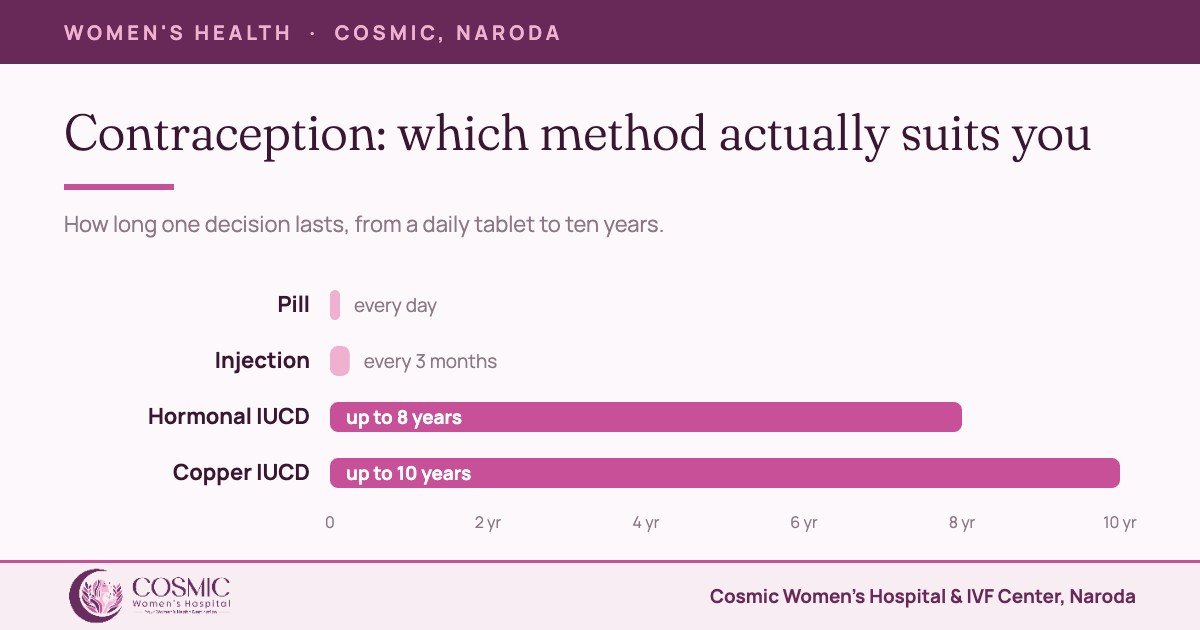
Both IUCDs are small devices placed inside the uterus in an outpatient procedure of a few minutes. Once one is in, nothing more depends on memory — which is why their real-world figures match their trial figures.
- The copper IUCD contains no hormone; a 380 mm² device is licensed for ten years. Periods often become heavier and more crampy, especially in the first few months.
- The hormonal IUCD releases a small amount of levonorgestrel into the uterus, and 52 mg devices are now supported for up to eight years. Periods usually become much lighter and for many women stop altogether — which is why the same device is first-line treatment for heavy periods under the NICE guideline, and is used for endometriosis pain.
Two things come up at almost every counselling session. An IUCD prevents a pregnancy from starting; it does not end one already started. And an IUCD does not cause infertility — fertility returns as soon as it is removed. If your periods are the real problem rather than contraception, the hormonal IUCD sits in both conversations at once: see heavy periods and the treatments that work.
What Indian data says about when an IUCD goes in
A study of 1,599 women at a tertiary hospital in Delhi compared copper IUCDs inserted immediately after a vaginal delivery, during a caesarean, within 48 hours of delivery, and as a routine procedure six weeks or more later. Continuation at six months was above 90% in every group, expulsion ranged from 0.8% at caesarean to 2.8% for delayed postpartum insertion, and there was one contraceptive failure in the whole series. So the first 48 hours after delivery is a real opportunity rather than a compromise, and it saves a separate visit with a newborn at home.
The injection and the pills
The three-monthly injection is given every 13 weeks, and can be up to four weeks late or two weeks early without losing cover. Three things are worth saying before the first dose rather than after it:
- Bleeding changes, and that is expected. Periods usually become irregular, then infrequent, and after a year many women have no bleeding at all. This is the drug working on the lining, not blood collecting inside.
- Weight. Average gain is about 1 to 2 kg a year, though many women have no significant change, and Asian women in particular tend not to gain weight on it.
- Fertility comes back slowly. Average time to conception after the last injection is around ten months. It is a good method for a gap of two or three years, and a poor one for the year before you plan a pregnancy.
Pills remain sensible for a woman who can take them reliably. The combined pill is not for everyone: blood pressure, migraine with aura, smoking after 35, any history of a clot and how recently you delivered are all checked against the WHO medical eligibility criteria at the consultation. The progestogen-only pill has a much shorter list of reasons not to use it, which is why it is the pill of choice while breastfeeding.
After a baby, and after a caesarean
Fertility can return as early as three weeks after childbirth, which is earlier than most couples assume. Exclusive breastfeeding is genuine contraception for the first six months, but only while feeds are frequent and periods have not returned — about 2 pregnancies per 100 women in that window as commonly practised.
| Time since delivery, breastfeeding | What can be started |
|---|---|
| First 48 hours | An IUCD can be fitted, including during a caesarean. Progestogen-only pill is suitable. The combined pill is not used. |
| 48 hours to 4 weeks | The IUCD window closes and reopens at 4 weeks. Progestogen-only pill continues to be suitable. |
| 4 weeks to 6 weeks | Both IUCDs are now unrestricted. The injection is usually deferred to 6 weeks while breastfeeding. |
| 6 weeks to 6 months | Progestogen-only pill, injection and both IUCDs are all unrestricted. |
| From 6 months | The combined pill becomes an option again, alongside everything above. |
Summarised from the WHO Medical eligibility criteria for contraceptive use, fifth edition. An IUCD is not inserted if there is puerperal sepsis.
This conversation belongs in the last few antenatal visits rather than on the postnatal ward: see how the route of delivery is decided.
If something has already gone wrong this week
Emergency contraception is a rescue, not a method. Three options exist and the differences between them matter.
The levonorgestrel pill may work less well at a higher body weight — not a reason to avoid it, but a reason to consider the copper IUCD if that can be arranged quickly. And the point that needs saying most often: an emergency contraceptive pill is not an abortion pill. It works by delaying ovulation and has no effect on a pregnancy that is already established.
Permanent methods, and the honest part
Sterilisation is counselled as permanent, for both men and women. Reversal exists as an operation but is not part of the plan and should not be in the back of anyone’s mind at consent. Where there is real doubt, an IUCD does the same job for eight or ten years and can be removed. Under India’s family planning programme the woman must be over 22, married with a living spouse, and must give her own written informed consent — the scheme’s manual does not require a husband’s consent. The programme also treats sterilisation failure as a compensable event, which is the clearest official acknowledgement that the failure rate is low but not zero.
Vasectomy deserves a sentence of its own: it is the smaller operation and its failure rate is lower, yet it accounts for 0.3% of modern contraceptive use in India against female sterilisation at nearly 67%. For a couple who have finished their family it is worth discussing before the woman is listed for surgery.
Across India, modern contraceptive use stands at 54.3% and unmet need has fallen to 9.4% from 13% five years earlier — but with the mix weighted so heavily towards one permanent method, the spacing options that would suit a woman of 26 wanting a three-year gap are the ones least often discussed.
At Cosmic
Contraception is discussed at an ordinary gynaecology consultation — there is no separate appointment for it, and no test is needed before the conversation. Both consultants hold OPD Monday to Saturday; for a woman who would prefer a female doctor, Dr. Bhargavi Khatri’s sessions are the ones to book.
The hormonal IUCD (LNG-IUS) is fitted here, and the same device is used in the treatment of heavy periods and of endometriosis pain. A pelvic ultrasound is done where the uterine cavity needs to be assessed before fitting, or to check the position of a device afterwards — pelvic ultrasound is Rs 1,200. Consultation is Rs 500 for a new general gynaecology case and Rs 300 for a follow-up.
If what you need is help conceiving rather than help avoiding it, the starting point is different — see age and fertility and a first gynaecology visit.
Ultrasound at Cosmic Women’s Hospital & IVF Center is used for diagnosis and monitoring only. Prenatal sex determination is not done here and is prohibited by law under the Pre-conception and Pre-natal Diagnostic Techniques (Prohibition of Sex Selection) Act, 1994.
To talk through which method fits the next few years — or to have an IUCD fitted, checked or removed — book a consultation at Cosmic Women’s Hospital & IVF Center, 3rd Floor, The Capital Corporate, near Naroda Muktidham, Naroda, Ahmedabad 382330. Call 77-9383-9383 or book an appointment. OPD Monday to Saturday, 10 am to 8 pm.
Sources
- World Health Organization and Johns Hopkins Center for Communication Programs. Family Planning: A Global Handbook for Providers — Appendix A, contraceptive effectiveness (after Trussell 2007; Cleland and Ali 2004), and Chapter 4, Progestin-Only Injectables (2022 edition).
- World Health Organization. Medical eligibility criteria for contraceptive use, fifth edition, executive summary. WHO/RHR/15.07, 2015.
- Faculty of Sexual and Reproductive Healthcare guidance on duration of intrauterine devices, as summarised in NHS Tayside Sexual and Reproductive Health Service, IUD and IUS device characteristics, October 2024.
- Gupta P, Gupta MM, Sharma R. Intrauterine copper device (CuT380A) as a contraceptive method in the Indian context: acceptability, safety and efficacy depending on the timing of insertion. Journal of Obstetrics and Gynaecology of India 2018;68(2):129–135.
- National Institute for Health and Care Excellence. NG88, Heavy menstrual bleeding: assessment and management.
- UNFPA India. Reimagining Family Planning in India, 2025, citing National Family Health Survey 5 (2019–21).
- Ministry of Health and Family Welfare, Government of India. Manual for Family Planning Indemnity Scheme.
- Reproductive Health National Training Center. Emergency contraception methods comparison, 2024.
- Pankh, a FOGSI initiative. Contraceptive Injectables.
Effectiveness figures quoted here are published international and national reference rates. They are not an audit of outcomes at this centre.
Written by the clinical team at Cosmic Women’s Hospital & IVF Center, Naroda, Ahmedabad.
Medically reviewed by Dr. Bhargavi Khatri, MBBS, MS Obgy (Gold Medalist), FRM — Consulting Obgyn, Infertility & IVF Specialist.
Reviewed 16 October 2026. This article is general information about contraceptive methods and is not a substitute for an individual consultation.
Where this is treated
Book a consultation
Tell us how we can help and we will call you back.

Cosmic Women's Hospital
Cosmic Women’s Hospital & IVF Center is a registered Level 2 ART clinic in Naroda, Ahmedabad — obstetrics, gynaecological surgery, IVF and ICSI, with ultrasound in-house and 24-hour emergency obstetric cover. Articles here are written by the clinical team and medically reviewed by Dr. Rahul Khatri or Dr. Bhargavi Khatri before publication.