Pregnancy
Thyroid in pregnancy: what the TSH test means, and when a tablet is started
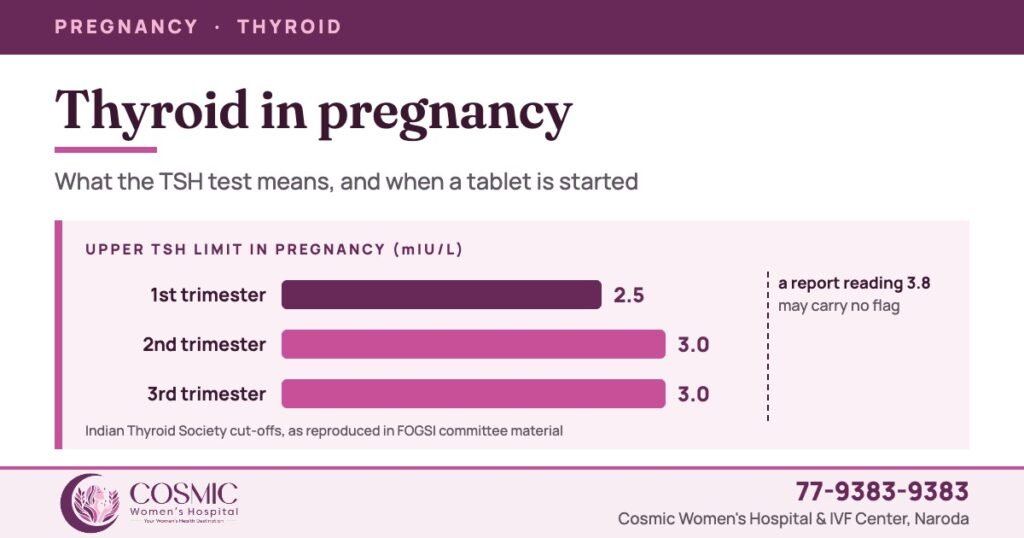
TSH limits in pregnancy are lower than on most lab reports: 2.5 in the first trimester, 3.0 after. When a thyroid tablet is started, how it is taken, and after delivery.
Thyroid disease in pregnancy is rarely dramatic. It usually arrives as a number on a blood report, in a woman who feels much as any other pregnant woman feels — tired, a little constipated, gaining weight. That is precisely why it is looked for rather than waited for. This page sets out what is tested, what the numbers mean in pregnancy as opposed to outside it, when a tablet is started, and what changes after delivery.
Why the thyroid matters more once you are pregnant
The demand on the thyroid gland rises in early pregnancy, at the same time as the baby has no thyroid function of its own. Until roughly 12 weeks the baby depends entirely on thyroid hormone crossing from the mother, which is why the first trimester is the part of pregnancy where an untreated deficiency matters most.
The FOGSI Endocrinology Committee lists anaemia, gestational hypertension, abruptio placentae, preterm birth, low birth weight, neonatal respiratory distress, postpartum haemorrhage, miscarriage and neurocognitive impairment in the child among the consequences of untreated hypothyroidism in pregnancy. It attaches no percentage to any of them, and neither do we. These are the risks treatment is meant to reduce, not odds that can be quoted at a first visit.
How often it is found in Indian pregnancies
A 2026 systematic review in the Indian Journal of Medical Research pooled 60 Indian studies and reported the following. These are figures from published Indian research, not this centre’s own audit.
| What was measured | Pooled prevalence in Indian pregnancies | 95% confidence interval |
|---|---|---|
| Hypothyroidism overall | 17% | 14% to 19% |
| Subclinical hypothyroidism | 15% | 12% to 18% |
| Overt hypothyroidism | 3% | 3% to 4% |
Two caveats belong with those numbers, and the authors state both: almost all the studies were hospital-based, so they describe women attending hospitals rather than the general population, and a quarter used different TSH cut-offs, with upper limits ranging from 4.0 to 10.0 mIU/L — which is why the same review calls for India-specific cut-offs. FOGSI’s own committee material puts India at about 11% against 1.5% to 4% worldwide. The figures differ; the conclusion does not. It is common enough to look for in every pregnancy rather than only in women who look unwell.
The number that gets misread
This is the part worth reading twice. A TSH of 3.8 mIU/L will often be printed without a flag, because most laboratory reference ranges are built from women who are not pregnant. Pregnancy ranges are lower.
The Indian Thyroid Society cut-offs, reproduced in FOGSI’s committee material, give upper limits of 2.5 mIU/L in the first trimester and 3.0 mIU/L in the second and third. The 2017 American Thyroid Association guideline asks each population to derive its own trimester-specific ranges instead, and says that where none exists the upper limit for the typical patient in early pregnancy is about 4.0 mU/L from roughly week 7 to week 12, returning gradually towards the non-pregnant range later.
| Stage of pregnancy | Upper limit of TSH, Indian Thyroid Society cut-offs | 2017 American Thyroid Association |
|---|---|---|
| First trimester | 2.5 mIU/L | Locally derived range preferred; about 4.0 mU/L (weeks 7 to 12) where none exists |
| Second trimester | 3.0 mIU/L | Gradual return towards the non-pregnant range |
| Third trimester | 3.0 mIU/L | Gradual return towards the non-pregnant range |
Who is tested, and when
FOGSI’s Endocrinology Committee advises screening at the first antenatal visit, with TSH, free T4 and anti-TPO antibody, and notes that the TPO antibody needs testing only once in a pregnancy. The argument for testing everyone rather than only women with symptoms or a family history is the prevalence above: most of what is found is subclinical, and subclinical hypothyroidism has no symptoms worth the name. What else that first appointment covers is set out on our page about the first pregnancy visit, including which previous reports to bring.
When a tablet is started
Levothyroxine is a replacement for a hormone the body is short of, not a drug added to pregnancy. The four treatment bands below are the ones FOGSI’s committee material sets out; the last two rows are the results that fall outside them.
| TSH on the report | Anti-TPO antibody | What the guidance advises |
|---|---|---|
| Above 10 mIU/L | Either result | Levothyroxine recommended |
| 4 to 10 mIU/L | Positive | Levothyroxine recommended |
| 4 to 10 mIU/L | Negative | Levothyroxine may be considered |
| 2.5 to 4 mIU/L | Positive | Levothyroxine may be considered |
| Below 4 mIU/L | Negative | Outside the treatment bands; no tablet on this result alone |
| Below 2.5 mIU/L | Positive | No tablet; TSH rechecked about every 4 weeks until mid-pregnancy |
The starting dose is given as 1.6 to 2.0 micrograms per kilogram per day, or started at 50 to 100 micrograms a day, with later adjustments of 12.5 to 25 micrograms either up or down. The target is a TSH of 2.5 mIU/L or below. Monitoring is roughly every four to six weeks until mid-pregnancy, and at least once near 28 weeks.
If you were already on thyroxine before conceiving
The requirement rises quickly. FOGSI’s guidance is to increase the levothyroxine dose by about 30% as soon as pregnancy is diagnosed, rather than waiting for the next appointment, and the preconception target for a woman planning pregnancy is a TSH between the lower reference limit and 2.5 mU/L. Bring the current prescription and the last report to the first visit — the dose decision is made from those two things.
Thyroid, difficulty conceiving, and IVF
The thyroid is checked early in a fertility work-up for a reason. The 2017 American Thyroid Association guideline recommends measuring TSH in all women seeking care for infertility, and levothyroxine for infertile women with overt hypothyroidism who want to conceive. For women with subclinical hypothyroidism going through IVF or ICSI it is firmer still: treat with levothyroxine, target TSH below 2.5 mU/L. Dr. Bhargavi Khatri leads the fertility and IVF programme here, and thyroid status is part of the work-up before a cycle is planned rather than something checked afterwards.
Where there have been repeated pregnancy losses the position is more careful than the internet suggests. In women whose thyroid function is normal but who are TPO-antibody positive and have had a previous loss, the same guideline says levothyroxine may be considered, and states plainly that the evidence is insufficient to show it reduces loss. It also advises against selenium supplementation for TPO-positive women in pregnancy. Our page on recurrent miscarriage sets out how that work-up runs.
An overactive thyroid in pregnancy
Much less common, and handled differently. FOGSI’s committee update advises starting propylthiouracil in the first trimester and switching to methimazole in the second, titrating on free T4 rather than TSH, with liver function watched on propylthiouracil. Radioactive iodine treatment is contraindicated in pregnancy. A transient, measurable overactivity can also appear in early pregnancy from the hCG of the pregnancy itself, particularly with severe vomiting — that is not Graves’ disease.
Iodine
The 2017 American Thyroid Association guideline recommends approximately 250 micrograms of iodine daily in pregnancy, and a daily supplement containing 150 micrograms as potassium iodide, ideally started three months before conception. It also advises avoiding an intake above 500 micrograms a day. More is not better here. This is the American guideline’s advice; ask at your visit before adding a separate iodine tablet to what you already take.
After the baby is born
The extra requirement disappears with the pregnancy. FOGSI’s guidance is to revert to the pre-pregnancy dose and recheck TSH after about six weeks. A woman who was started on levothyroxine only during this pregnancy should ask at the postnatal visit whether she still needs it; that is decided on a repeat TSH, not stopped on her own. Where thyroid autoimmunity is present, annual TSH monitoring is advised.
Postpartum thyroiditis is a separate problem — a temporary inflammation that FOGSI material puts at up to 10% of pregnancies, often overactive first and underactive later. Routine screening of everybody for it is not recommended; TSH at three and six months after delivery is advised for the highest-risk groups, including women who were TPO-positive in the first trimester, women with type 1 diabetes and women with postpartum depression.
At Cosmic
- A thyroid test is part of the first antenatal visit for every woman booking here, not only for women with symptoms or a family history.
- Blood samples, including thyroid tests, are taken at the hospital.
- Both consultants, Dr. Rahul Khatri and Dr. Bhargavi Khatri, run antenatal clinics and manage pregnancy including high-risk pregnancy — the report is reviewed at the visit it is brought to, and the dose changed then rather than at a separate appointment.
- Women already on levothyroxine should bring their prescription and most recent report to the first visit.
- Dr. Bhargavi Khatri leads fertility and IVF; thyroid status is part of the work-up before a cycle.
- OPD Monday to Saturday, 10 am to 8 pm. Naroda, Ahmedabad. Telephone 77-9383-9383.
Related reading: high-risk pregnancy care, gestational diabetes in pregnancy, and your first pregnancy visit.
This page is general information and is not a substitute for assessment of your own pregnancy. Dose decisions depend on your weight, your reports and your history, and are made in consultation.
Sources
- Manna S, Mukherjee R, Kandpal V, Zode M, Kulkarni B, Lyngdoh T. Prevalence of hypothyroidism among pregnant women and associated feto-maternal outcomes in India: systematic review and meta-analysis. Indian Journal of Medical Research 2026;163(6):745–762. doi:10.25259/IJMR_2554_2025
- FOGSI Endocrinology Committee. Hypothyroidism in Pregnancy (committee information material, 2022–23). Federation of Obstetric and Gynaecological Societies of India.
- FOGSI Medical Disorders in Pregnancy Committee. Thyroid Update in Pregnancy, Vol. 2, January 2021 — including the Indian Thyroid Society 2012 trimester cut-offs and the Indian Thyroid Society and FOGSI 2019 recommendations reproduced in it.
- Alexander EK, Pearce EN, Brent GA, et al. 2017 Guidelines of the American Thyroid Association for the Diagnosis and Management of Thyroid Disease During Pregnancy and the Postpartum. Thyroid 2017;27(3):315–389. doi:10.1089/thy.2016.0457
Prevalence figures quoted here are from published Indian research and are overall figures for the studies concerned, not this centre’s own results.
More on pregnancy
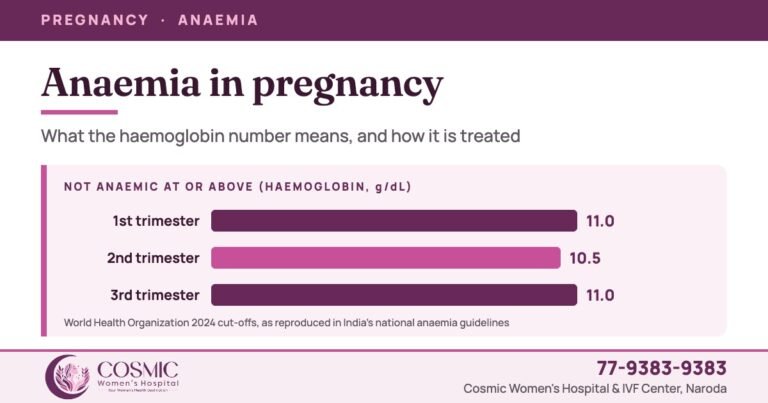 PregnancyAnaemia in pregnancy: what the haemoglobin number means and how it is treatedWhat counts as anaemia in each trimester, how iron tablets should be taken, and when an iron infusion or a transfusion is needed. Haemoglobin cut-offs explained.11 November 2026
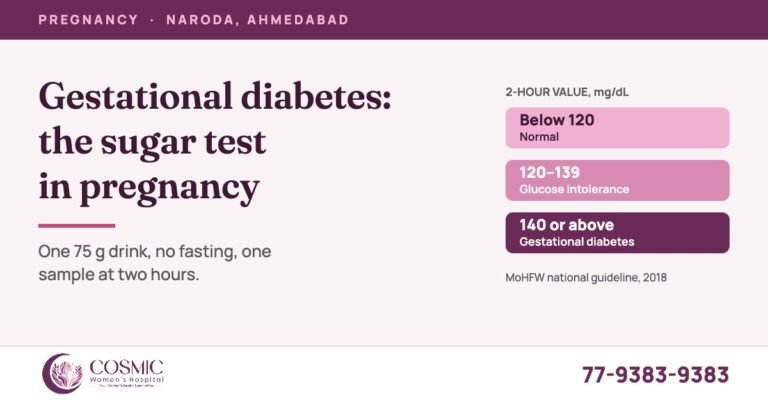 PregnancyGestational diabetes: the sugar test in pregnancy, and what happens if it is positiveSugar in pregnancy explained — the 75 g test, what 140 mg/dL means, diet, insulin or metformin, growth scans and the test after delivery. Naroda, Ahmedabad.7 November 2026
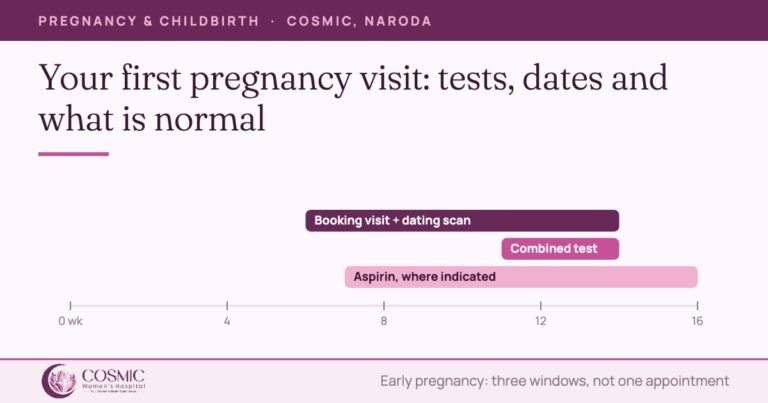 PregnancyYour First Pregnancy Visit: Tests, Dates and What Is NormalYour first antenatal visit at Cosmic, Naroda: the history, the dating scan, the blood tests, how your due date is fixed and how often you are seen after it.10 October 2026