
Pregnancy
Gestational diabetes: the sugar test in pregnancy, and what happens if it is positive
Sugar in pregnancy explained — the 75 g test, what 140 mg/dL means, diet, insulin or metformin, growth scans and the test after delivery. Naroda, Ahmedabad.

Gestational diabetes mellitus (GDM) is diabetes that appears for the first time during pregnancy. The placenta makes hormones that work against insulin, and in some women the pancreas cannot keep up, so the blood sugar rises. It usually causes no symptoms at all — which is why it is looked for in every pregnancy rather than only in women who feel unwell. Most women who have it go on to a normal pregnancy and a healthy baby; what makes the difference is finding it, because the sugar crosses to the baby even though the mother’s insulin does not.
How common is it in India?
It is common. The Government of India’s national guideline puts the rate at 10 to 14.3% of pregnancies, and a 2024 systematic review pooling 110 Indian studies found an overall figure of 13% (95% CI 9–16%) — 12% (9–16%) in urban populations, 10% (6–13%) in rural ones. Individual studies in that review ranged from 3% to 35%, because they used different tests in different populations, so 13% is a broad national estimate rather than a precise rate for any one city. Roughly one woman in eight. That is why the test is offered to everyone.
The test: one drink, two hours, no fasting
India has deliberately standardised on a single test, described by the national guideline as “One Nation, One Test”. You are given 75 g of glucose dissolved in about 300 ml of water, to be finished in 5 to 10 minutes, and your blood sugar is checked exactly two hours later.
Two things about it surprise people. You do not have to come fasting — the guideline gives the glucose “whether the pregnant woman comes in fasting or non-fasting state, irrespective of the last meal”. And only one blood sample is taken, at the two-hour mark; there is no hourly series of pricks. If you vomit within 30 minutes of drinking the glucose, the test does not count and is repeated the next day.
| Two-hour value | What it is called | What follows |
|---|---|---|
| Below 120 mg/dL | Normal | Routine antenatal care; test repeated once, as below |
| 120–139 mg/dL | Gestational glucose intolerance | Not diabetes, but it needs following up rather than filing away |
| 140 mg/dL or above | Gestational diabetes | Diet and exercise start straight away; medicines if that is not enough |
One number, met or exceeded, makes the diagnosis. There is no second confirmatory test before treatment starts.
When the test is done
| Point in pregnancy | Test | Why then |
|---|---|---|
| First antenatal visit, as early as possible | 75 g test | About a third of women with gestational diabetes are picked up in the first trimester — and some of them have diabetes that was already there before pregnancy |
| 24–28 weeks (at least 4 weeks after the first test) | 75 g test repeated if the first was normal | Insulin resistance peaks in the second half of pregnancy, so a normal early test does not settle the question |
| Booking after 28 weeks | One test, at that first contact | No time for two |
| 32–34 weeks, in higher-risk women | May be repeated again | FOGSI’s recommendation for women who remain a concern |
This is also where the first pregnancy visit matters more than it looks: the sugar test belongs to that visit, alongside the blood group, haemoglobin, thyroid and dating scan.
Who gets tested — and why there is no risk list
Screening in India is universal. Being young, slim, vegetarian or in a first pregnancy does not take you out of it; the guideline’s reasoning is that women of Indian origin carry a higher risk of gestational diabetes and of type 2 diabetes afterwards. Some conditions raise the stakes rather than change the test — the 2023 international PCOS guideline, for instance, recommends that every pregnant woman with PCOS be offered the glucose test at 24–28 weeks. If you are already under high-risk pregnancy care, the sugar result is read alongside everything else being watched.
If the test is positive: diet first, medicines if needed
Treatment starts with food and walking, not with injections. The national protocol gives medical nutrition therapy and exercise a two-week trial — one week if the diagnosis is made in the third trimester, because there is less time — and then rechecks the two-hour post-meal sugar. What that trial involves:
- Carbohydrate held to 35–45% of the day’s calories, with a minimum of about 135 g a day, split across three small-to-moderate meals and two to four snacks. Not a starvation diet — the baby is growing.
- Protein about 1.5 g per kg per day; fibre 30–40 g a day; saturated fat under 10% of calories.
- Thirty minutes of moderate exercise — walking counts — on at least five days a week, or 150 minutes a week.
For many women that is the whole treatment. If the sugars stay up, medicines are added against these targets:
| Reading | Target |
|---|---|
| Fasting / before a meal | Under 95 mg/dL |
| 1 hour after a meal | Under 140 mg/dL |
| 2 hours after a meal | Under 120 mg/dL |
Insulin is the first choice of drug, for one clear reason: it does not cross the placenta, so it treats the mother without reaching the baby. The needle is fine and short, the injection goes into the skin of the abdomen or thigh, and most women soon learn to give it themselves.
Metformin is a tablet alternative where insulin is declined, unaffordable or cannot be given safely — the national guideline places it after 20 weeks of pregnancy, usually 500 mg twice daily and up to 2 g a day. Worth knowing in advance: 26–50% of women started on metformin eventually need insulin as well, so being moved onto it later is not a sign that anything has gone wrong. Where the sugar is very high at diagnosis — fasting above 126 mg/dL or two-hour above 200 mg/dL — insulin may be started straight away rather than waiting out a diet trial.
What changes in the rest of the pregnancy
A diagnosis mainly adds monitoring. Blood sugars are checked at home several times a day while the dose is being settled, and the profile is reviewed roughly weekly until it is stable. Antenatal visits become more frequent. From 28 weeks onwards the baby’s growth and the amniotic fluid are measured by ultrasound every three to four weeks, because the one thing a well-looking mother cannot feel is a baby growing too fast — this is what the growth scan and colour Doppler are for. Daily fetal movement counting starts at 32 weeks.
Where the sugars are controlled on diet alone and the baby is growing normally, no extra fetal testing is needed and delivery before 39 weeks is not recommended. Where control is poor, delivery between 37 and 39 weeks may be advised. Vaginal delivery remains the aim; a caesarean is for the usual obstetric reasons or for a baby estimated to be very large, and that decision is made with you rather than announced.
The complications all of this is designed to avoid are well described: for the mother, excess amniotic fluid, pre-eclampsia, prolonged or obstructed labour, caesarean delivery and postpartum bleeding; for the baby, an unusually large birth weight, shoulder dystocia and birth injury, low blood sugar in the first hours after birth and breathing difficulty. Good control reduces the risk of pre-eclampsia, shoulder dystocia and a large-for-dates baby. In Indian babies a birth weight above 3.45 kg at term is already considered large.
After delivery: the test most women miss
Gestational diabetes usually disappears when the placenta does — but it leaves a marker. Women who have had it carry roughly a ten-fold higher risk of type 2 diabetes later, and it returns in about two-thirds of later pregnancies. So one appointment matters more than any other: a repeat 75 g glucose test six weeks after delivery, and if that is normal, a sugar check once a year thereafter. It is an easy appointment to miss once the baby is home, and one of the simplest to keep. Early, frequent breastfeeding — starting within half an hour of birth — also helps keep the baby’s own sugar steady.
At Cosmic
Pregnancy care at Cosmic Women’s Hospital is shared by Dr. Rahul Khatri and Dr. Bhargavi Khatri — both manage antenatal care, high-risk pregnancy, deliveries and caesarean sections, and both perform and report the scans themselves. The glucose test is part of routine antenatal care here and the sample is taken at the hospital, so it does not mean a separate trip to a laboratory.
Antenatal visits run 3-weekly in the first trimester, 4-weekly in the second, 3-weekly in the seventh month, 2-weekly in the eighth and weekly in the ninth — a schedule that already suits the closer watch gestational diabetes needs. A growth scan with colour Doppler is done routinely at 32 to 34 weeks, and more often where there is a reason. Obstetric ultrasound is ₹1,200 and colour Doppler ₹1,500; 3D and 4D imaging, where it is useful, carries no extra charge. OPD is Monday to Saturday, 10 am to 8 pm, with 24-hour emergency obstetric cover.
To book: call 77-9383-9383 or book online.
Prenatal sex determination is not done at Cosmic Women’s Hospital and is prohibited by law under the Pre-conception and Pre-natal Diagnostic Techniques (PC&PNDT) Act, 1994. Every ultrasound described here is performed for medical reasons only.
This article is general information about pregnancy care and is not a substitute for a consultation. Blood sugar targets, doses and the timing of delivery are decided for each woman individually.
Sources
- Ministry of Health and Family Welfare, Government of India, Maternal Health Division, National Health Mission. Diagnosis & Management of Gestational Diabetes Mellitus — Technical and Operational Guidelines, 2018.
- FOGSI–ICOG Good Clinical Practice Recommendations. Hyperglycemia in Pregnancy: Optimizing Pregnancy Outcome. Federation of Obstetric and Gynaecological Societies of India / Indian College of Obstetricians and Gynaecologists (document dated 2024).
- Mantri N, Goel AD, Patel M, et al. National and regional prevalence of gestational diabetes mellitus in India: a systematic review and meta-analysis. BMC Public Health 2024;24:527. doi:10.1186/s12889-024-18024-9
- Teede HJ, Tay CT, Laven J, et al. International Evidence-based Guideline for the Assessment and Management of Polycystic Ovary Syndrome 2023. Hum Reprod 2023. doi:10.1093/humrep/dead156 (recommendation on glucose testing at 24–28 weeks in pregnant women with PCOS).
More on pregnancy
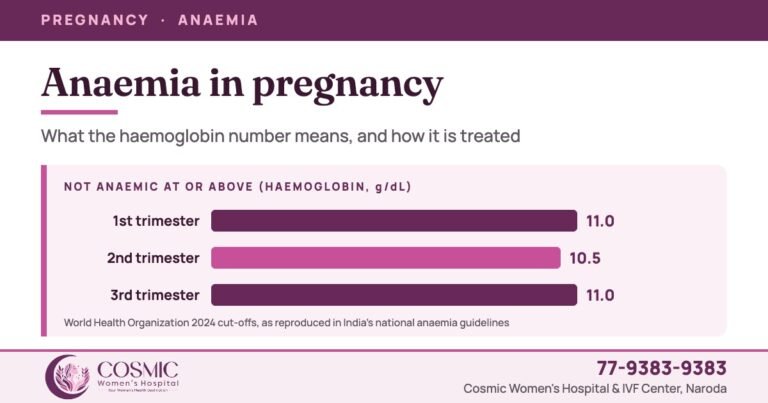 PregnancyAnaemia in pregnancy: what the haemoglobin number means and how it is treatedWhat counts as anaemia in each trimester, how iron tablets should be taken, and when an iron infusion or a transfusion is needed. Haemoglobin cut-offs explained.11 November 2026
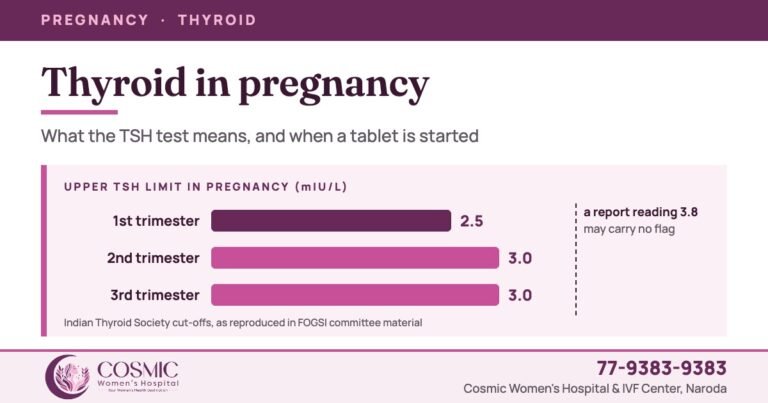 PregnancyThyroid in pregnancy: what the TSH test means, and when a tablet is startedTSH limits in pregnancy are lower than on most lab reports: 2.5 in the first trimester, 3.0 after. When a thyroid tablet is started, how it is taken, and after delivery.9 November 2026
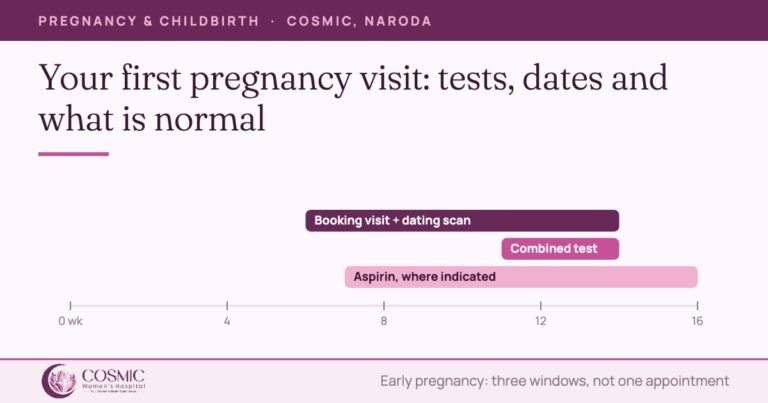 PregnancyYour First Pregnancy Visit: Tests, Dates and What Is NormalYour first antenatal visit at Cosmic, Naroda: the history, the dating scan, the blood tests, how your due date is fixed and how often you are seen after it.10 October 2026