
Pregnancy
Anaemia in pregnancy: what the haemoglobin number means and how it is treated
What counts as anaemia in each trimester, how iron tablets should be taken, and when an iron infusion or a transfusion is needed. Haemoglobin cut-offs explained.

Haemoglobin is the number on an antenatal report most often read and least often explained. A woman is told she is “anaemic”, handed a strip of iron tablets and sent home, with no sense of whether her reading is mildly low or dangerous, how long the tablets take to work, or what happens if they do not.
This matters in Gujarat more than the national figure suggests. In the National Family Health Survey of 2019–21, 62.6% of pregnant women aged 15–49 in Gujarat were anaemic, against 52.2% for India as a whole. Five years earlier the Gujarat figure had been 51.3%. It did not improve; it rose.
What counts as anaemia in pregnancy
Haemoglobin falls in every normal pregnancy. Blood volume expands faster than red cells are made, so the same woman will read lower at 24 weeks than she did at 8 weeks without anything having gone wrong. That is why the cut-off itself changes with the trimester — and in 2024 the World Health Organization lowered the middle one to reflect it.
| Haemoglobin | First and third trimester | Second trimester |
|---|---|---|
| Not anaemic | 11.0 g/dL or above | 10.5 g/dL or above |
| Mild anaemia | 10.0 – 10.9 g/dL | 9.5 – 10.4 g/dL |
| Moderate anaemia | 7.0 – 9.9 g/dL | 7.0 – 9.4 g/dL |
| Severe anaemia | Below 7.0 g/dL | Below 7.0 g/dL |
Two practical points follow. A reading of 10.7 g/dL is mild anaemia in the first trimester and not anaemia at all in the second. And a figure quoted from a finger-prick screening device is a screening result: national guidance is explicit that venous blood is the standard for confirming a haemoglobin level, with the finger-prick reserved for rapid testing in the field.
Low haemoglobin is not automatically iron deficiency
Iron deficiency is the commonest cause, and roughly half of all anaemia worldwide is attributed to it — but not all of it. A full blood count, the red-cell indices and a peripheral smear usually separate iron deficiency from a thalassaemia trait or a vitamin B12 or folate deficiency. Where there is doubt, serum ferritin settles it: Indian guidance treats a ferritin below 30 µg/L as early iron depletion worth correcting.
This distinction is not academic in Gujarat, where both thalassaemia trait and sickle cell trait are seen. National guidance puts it bluntly: a woman whose haemoglobin has not responded to iron should not simply be given more iron without first ruling out a haemoglobinopathy. If your haemoglobin has stayed flat on tablets, that is the question to ask, not a higher dose.
Iron tablets: the dose, and the way they are taken
Under India’s Anemia Mukt Bharat programme, every pregnant woman is offered one red iron-folic-acid tablet a day — 60 mg of elemental iron with 500 mcg of folic acid — for 180 days from the second trimester onwards, whether or not she is anaemic. Where mild or moderate anaemia is already present, the treatment dose is two of those tablets a day for a month, with the haemoglobin rechecked at the end of it. FOGSI’s own recommendation for established mild to moderate anaemia before about 30–32 weeks is similar in spirit and higher in dose: 100 mg of elemental iron twice daily with folic acid, and a repeat haemoglobin after four weeks.
A rise of at least 1 g/dL after a month of tablets is the test of whether they are working. Less than that counts as non-response, and the answer is investigation rather than persistence. Once the haemoglobin is back to target, treatment continues for a further two to three months to refill the iron stores, then drops back to the once-a-day prophylactic dose for the rest of the pregnancy.
Four things that decide whether the tablet works
- Take it on an empty stomach, or at least an hour after food. If nausea makes that impossible, take it after food — an absorbed tablet taken imperfectly beats a perfect tablet that was never swallowed.
- Vitamin C helps. A citrus fruit, guava or amla with the tablet helps absorption.
- Keep it away from tea, coffee, milk and the calcium tablet. All four reduce iron absorption; the calcium tablet should be taken at a different time of day.
- Black stools are expected, not a complication. Constipation, nausea and an upset stomach are the common reasons women quietly stop — say so at the visit, because the dose, the timing or the salt can be changed.
When an injection is the right answer
Intravenous iron is not a stronger version of the tablet for people in a hurry; it has specific indications. It is used where oral iron is not tolerated or not absorbed, where it has failed to raise the haemoglobin, or where there is simply not enough time left in the pregnancy for tablets to work. Indian guidance places it from the second trimester onwards — there is no evidence base for intravenous iron in the first trimester, and it is not given then — and in a facility equipped to manage a reaction.
Two preparations are in routine use. Iron sucrose is given as a course of several smaller infusions; ferric carboxymaltose delivers up to 1,000 mg of iron in a single sitting, so a correction that takes five visits with one takes two with the other. FOGSI’s guidance is to recheck the haemoglobin four weeks after the infusion, and to look for another cause if it has not risen by at least 1 g/dL. Neither is appropriate where the anaemia is not due to iron deficiency, where there is iron overload, or where there has been a previous reaction to intravenous iron.
When a transfusion is justified — and when it is not
Blood transfusion corrects a haemoglobin faster than anything else, which is exactly why it needs a threshold rather than a reflex. FOGSI’s guidance sets it by how far the pregnancy has gone:
| Situation | Transfusion considered |
|---|---|
| Before 34 weeks | Haemoglobin below 5 g/dL; or 5–7 g/dL where heart failure is threatened |
| After 34 weeks | Haemoglobin below 7 g/dL, even without signs of strain |
| In labour | Haemoglobin below 7 g/dL, judged with the history and symptoms |
| Active bleeding | Haemoglobin below 6 g/dL, or haemodynamic instability at any level |
| After delivery | Haemoglobin below 7 g/dL, judged with the history and symptoms; or signs of shock |
What is actually at stake
A published study cited in FOGSI’s recommendations, comparing anaemic with non-anaemic mothers, reported roughly four times the rate of preterm birth, about twice the rate of low birth weight, and more low Apgar scores at one minute — figures from the published literature, not from this hospital’s records. The reassuring side of the same evidence is that correction works: a Cochrane review found preventive iron cut anaemia at term by about 70% and iron deficiency by 57%, although its reduction in low birth weight, 8.4% against 10.3%, did not reach statistical significance.
Anaemia also travels with other first-visit findings. It is worth reading alongside thyroid testing in pregnancy and what the first pregnancy visit covers, and, where the haemoglobin is low enough to matter for fetal growth, with high-risk pregnancy care and the growth scan and colour Doppler.
At Cosmic
Haemoglobin is checked at the first antenatal visit and rechecked as the pregnancy advances, and visits run on a schedule that tightens towards delivery — three-weekly in the first trimester, four-weekly in the second, three-weekly in the seventh month, two-weekly in the eighth and weekly in the ninth. That rhythm matters for anaemia specifically, because it is what catches a haemoglobin that has stopped responding while there is still time to change course. Blood samples are taken here, ultrasound including the growth scan with colour Doppler is done and reported in-house by Dr. Rahul Khatri and Dr. Bhargavi Khatri, and emergency obstetric cover runs 24 hours. Whether a given woman needs tablets, an infusion or admission is decided at the consultation, with her report in hand.
Prenatal sex determination is not done at Cosmic Women’s Hospital & IVF Center and is prohibited by law under the Pre-conception and Pre-natal Diagnostic Techniques (Prohibition of Sex Selection) Act, 1994.
This article is general information about a medical condition and is not a substitute for a consultation. Haemoglobin thresholds, doses and treatment routes described here are drawn from published national guidance; the decision in any individual pregnancy depends on the full clinical picture.
Sources
- Ministry of Health and Family Welfare, Government of India. Anaemia Mukt Bharat — Lok Sabha reply with annexure “Anemia Prevalence (NFHS-4 and NFHS-5)”, Press Information Bureau, 4 February 2022. Pregnant women aged 15–49 anaemic (<11.0 g/dL): India 52.2% (NFHS-5) and 50.4% (NFHS-4); Gujarat 62.6% and 51.3%.
- Ministry of Health and Family Welfare, Nutrition Division. Anemia Mukt Bharat Abhiyaan Operational Guidelines, June 2026. World Health Organization 2024 haemoglobin cut-offs; red IFA tablet 60 mg elemental iron with 500 mcg folic acid, 180 days from the second trimester; therapeutic two tablets daily for one month; non-response defined as a rise under 1 g/dL at one month; continuation for two to three months after normalisation; venous blood as the standard for confirmation; caution against empirical iron in a non-responder before excluding a haemoglobinopathy.
- Federation of Obstetric and Gynaecological Societies of India. FOGSI General Clinical Practice Recommendations: Management of Iron Deficiency Anemia in Pregnancy (chairperson Dr. Alka Kriplani; coordinators Dr. Aparna Sharma and Dr. A. G. Radhika). Recommendation 1.1 (100 mg elemental iron twice daily with 500 µg folic acid, repeat haemoglobin at four weeks); recommendation 1.3 (tablet before meals or at least one hour after, with vitamin C; avoid tea, coffee, milk and calcium tablets); serum ferritin below 30 µg/L; parenteral iron from the second trimester and not in the first; transfusion thresholds; outcome figures attributed in that document to Lone et al. and to a Cochrane review of prophylactic iron.
- Federation of Obstetric and Gynaecological Societies of India. Frequently Asked Questions on Intravenous Ferric Carboxymaltose (FAQ document on the FOGSI website, February 2025). Use from the second trimester onwards in moderate to severe anaemia; up to 1,000 mg of iron in a single infusion against 200–300 mg per dose of iron sucrose; recheck haemoglobin four weeks after infusion; investigate other causes if the rise is under 1 g/dL; contraindications including iron overload, non-iron-deficiency anaemia and known hypersensitivity.
- World Health Organization estimate that approximately 50% of anaemia is attributable to iron deficiency, as cited in source 2 above.
Booking a consultation
Cosmic Women’s Hospital & IVF Center, 3rd Floor, The Capital Corporate, Nr. Naroda Muktidham, Naroda, Ahmedabad – 382330. OPD Monday to Saturday, 10 am to 8 pm. Telephone 77-9383-9383. Request an appointment.
More on pregnancy
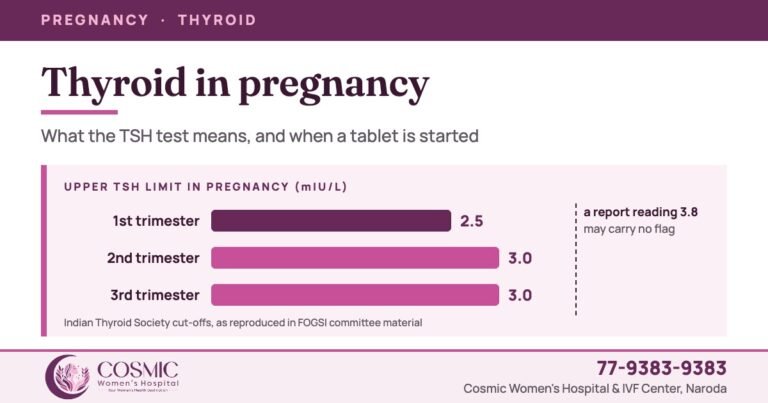 PregnancyThyroid in pregnancy: what the TSH test means, and when a tablet is startedTSH limits in pregnancy are lower than on most lab reports: 2.5 in the first trimester, 3.0 after. When a thyroid tablet is started, how it is taken, and after delivery.9 November 2026
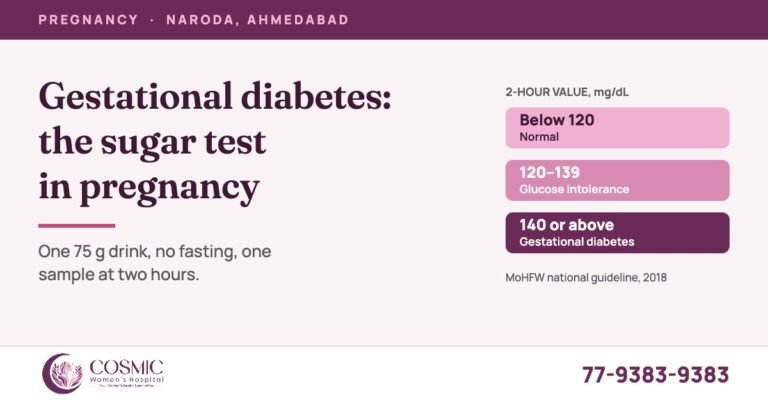 PregnancyGestational diabetes: the sugar test in pregnancy, and what happens if it is positiveSugar in pregnancy explained — the 75 g test, what 140 mg/dL means, diet, insulin or metformin, growth scans and the test after delivery. Naroda, Ahmedabad.7 November 2026
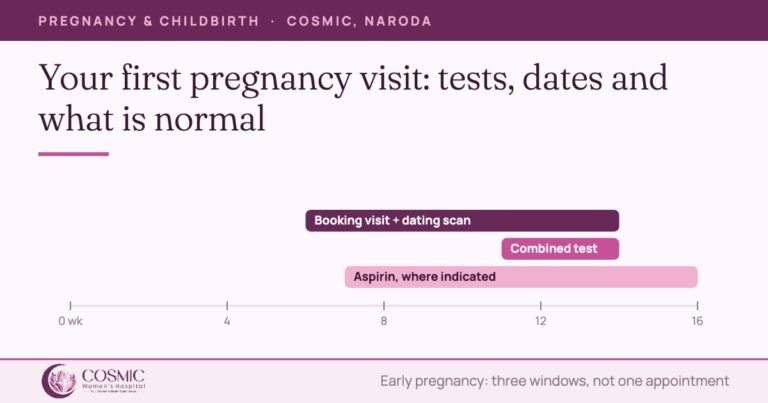 PregnancyYour First Pregnancy Visit: Tests, Dates and What Is NormalYour first antenatal visit at Cosmic, Naroda: the history, the dating scan, the blood tests, how your due date is fixed and how often you are seen after it.10 October 2026