Being told your pregnancy is “high risk” sounds like a verdict. It is not. It is a decision about how closely you are watched and what is planned in advance — and for most women it ends in a normal, healthy delivery.
“High risk” is a label your obstetrician puts on a plan, not on you. It means one or more things about your health, your history or this pregnancy make a complication more likely than average — so the pregnancy is monitored more closely, some things are started earlier, and the delivery is arranged where the right people and equipment are already in place.
The label often arrives without much explanation, and the internet then supplies the worst version. This page explains what puts a pregnancy in that group, what genuinely changes in your care, and what we do about each of the common problems.
What makes a pregnancy high risk
Broadly, four things: something about you before you conceived, something in your obstetric history, something that has developed in this pregnancy, or something about the baby.
| Group | Common examples |
|---|---|
| Your health before pregnancy | High blood pressure, diabetes (type 1 or 2), thyroid disease, heart or kidney disease, epilepsy, autoimmune disease such as lupus or antiphospholipid syndrome, significant obesity, age over 35 |
| Your obstetric history | Previous caesarean, previous pre-eclampsia, previous preterm delivery, previous stillbirth or growth-restricted baby, three or more miscarriages, previous surgery on the uterus |
| This pregnancy | Twins or triplets, pregnancy after IVF, pre-eclampsia or gestational hypertension, gestational diabetes, low-lying placenta, bleeding, short cervix, severe anaemia, low or high liquor |
| The baby | Poor growth on scan, abnormal Doppler flow, an abnormality found on the anomaly scan, reduced movements |
Two of these are common enough in India to deserve a number. Anaemia affects 52.2% of pregnant women aged 15–49 nationally (NFHS-5, 2019–21). Gestational diabetes has a pooled Indian prevalence of about 13% (95% CI 9–16) across 117 studies, though the pooled figure for the western zone, which includes Gujarat, was lower at 7%. Neither is rare, and both are the kind of problem that is easy to manage early and hard to manage late.
What the government counts as a high-risk pregnancy
If you have been told at a government centre or by your ASHA that your pregnancy is “high risk”, this is what that label usually means. Under the Pradhan Mantri Surakshit Matritva Abhiyan (PMSMA), which Gujarat has run since June 2016, the Ministry of Health and Family Welfare screens every pregnancy against a list of 25 high-risk categories, expanded in recent years from an original ten.
| Group | Categories on the official list |
|---|---|
| Infections | HIV, syphilis, hepatitis B, tuberculosis, malaria, reproductive tract or sexually transmitted infection, high fever |
| Medical conditions | Severe anaemia, pregnancy-induced hypertension, gestational diabetes, hypothyroidism |
| Past pregnancies | Previous caesarean (LSCS), bad obstetric history, history of stillbirth |
| This pregnancy | Twins or more, cephalo-pelvic disproportion, abnormal fetal heart rate, congenital malformation, Rh-negative blood group |
| The mother | Teenage pregnancy, first pregnancy at a young age, first pregnancy at an older age, grand multipara, short stature |
| Others, at the doctor’s judgement |
A pregnancy found to have any of these is marked with a red sticker on the Mother and Child Protection card, and the guidance is to plan delivery at a facility that provides assured emergency obstetric care. The PMSMA guidelines use four colours in all:
Since 2022, the Extended PMSMA has added three extra antenatal visits with a doctor for every woman marked high-risk, with the ASHA accompanying her, a transport allowance of Rs 100 per visit for up to three visits, and follow-up until 45 days after delivery.
Severe anaemia, in numbers
Severe anaemia is the one category on the list with a clear number attached, and the cut-offs are worth knowing. The Ministry’s Anaemia Mukt Bharat guidelines grade anaemia in pregnancy by haemoglobin:
| Grade | Haemoglobin (g/dl) |
|---|---|
| Mild | 10.0 – 10.9 |
| Moderate | 7.0 – 9.9 |
| Severe | Below 7.0 |
Below 5 g/dl the guideline advises immediate admission, at any stage of pregnancy, to a hospital with specialist care around the clock.
How this fits with the care described above. The government list is a screening tool, built so that no high-risk woman is missed anywhere in the state. It is deliberately broad. A red sticker means you need closer care and a planned place of delivery; it does not by itself mean something is going wrong. Whether your pregnancy is high risk, and what that changes, is worked out at your own consultation.
What changes in your antenatal care
Not everything. The blood tests, the folic acid and iron, the anomaly scan — those are the same. What changes is the frequency, and what gets added.
| Routine pregnancy | High-risk pregnancy | |
|---|---|---|
| Visits | Every 3 to 4 weeks until the seventh month, then progressively closer — the schedule is set out below | Often fortnightly from 28 weeks and weekly from 36, and sooner if a problem is being tracked |
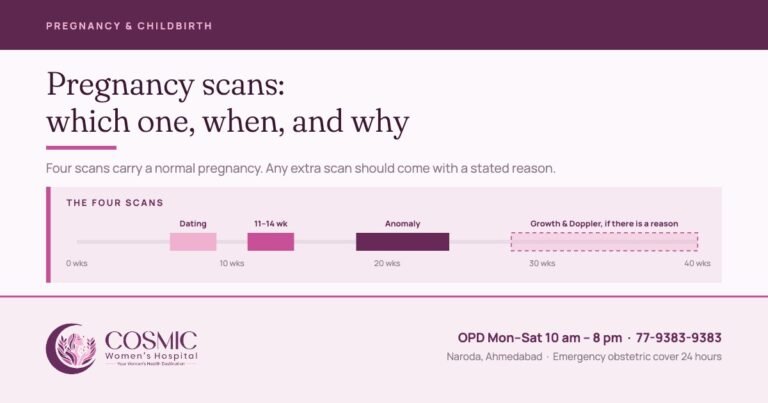
| Scans | Dating, NT, anomaly, one growth scan | Serial growth scans, usually every 2–4 weeks in the third trimester, with colour Doppler where growth or blood flow is a concern |
| BP and urine | Every visit | Every visit plus home BP monitoring in some women |
| Extra | — | Cervical length measurement, fetal echo, physician or endocrinologist input, anaesthetic review before delivery |
The visit schedule followed at Cosmic
Schedules differ between units, and a table in a textbook is not the same as what your own doctor does. This is the schedule Dr. Rahul Khatri follows, and it is what to expect if you book here. It is a floor, not a ceiling — a blood pressure reading, a scan or a symptom brings the next visit forward, and in a pregnancy being tracked for a specific problem you will be seen more often than this.
| Stage of pregnancy | How often you are seen |
|---|---|
| First trimester, to about 13 weeks | Every 3 weeks |
| Second trimester, to about 26 weeks | Every 4 weeks |
| Seventh month, about 27 to 31 weeks | Every 3 weeks |
| Eighth month, about 32 to 35 weeks | Every 2 weeks |
| Ninth month, 36 weeks to delivery | Every week |
Two practical points. Bring your file to every visit, including the scan reports — a growth chart is only useful if the earlier measurements are in front of the doctor. And if you are travelling in from outside Ahmedabad, the third-trimester visits are the ones to plan around; the first two trimesters are spaced widely enough to fit an ordinary month.
PC&PNDT: Determination of the sex of the fetus is not done at Cosmic Women’s Hospital and is prohibited by law under the Pre-Conception and Pre-Natal Diagnostic Techniques (Prohibition of Sex Selection) Act, 1994. Every ultrasound here is performed for a medical indication only.
The common problems, and what we do
High blood pressure and pre-eclampsia
Pre-eclampsia is the reason your BP and urine are checked at every single visit. The important part is prevention, and it is started early: low-dose aspirin reduces pre-eclampsia, preterm birth and growth restriction in women at risk. The US Preventive Services Task Force gives this a Grade B recommendation at 81 mg daily; Indian practice commonly uses 75–150 mg, and the dose is decided at your booking visit.
When it is started here. At Cosmic, a woman who needs aspirin is usually started at about 7 weeks, as soon as the pregnancy is confirmed on scan, at a dose of 150 mg daily — the dose used in the ASPRE trial, the largest randomised trial of aspirin for preventing preterm pre-eclampsia. That is earlier than the 12-week mark the USPSTF statement is written around, and earlier than the trials it rests on, which began aspirin between 11 and 16 weeks — so an earlier start is a clinical judgement made for you, not a guideline instruction. What the evidence agrees on is that late is worse than early: aspirin started after 16 weeks does considerably less.
You qualify on one of these: previous pre-eclampsia, twins, chronic hypertension, pre-existing diabetes, kidney disease, or autoimmune disease such as lupus or antiphospholipid syndrome. You also qualify on two of the moderate factors — first pregnancy, BMI over 30, family history of pre-eclampsia, age 35 or over, or conception through IVF. That last one matters: a good number of women who conceive with us in the IVF programme should be on aspirin from the first trimester.
Gestational diabetes
India screens every pregnant woman, not just those who look at risk — the national guideline uses a single-step 75 g oral glucose test that does not require fasting, at the first antenatal contact and again at 24–28 weeks. Most women who test positive control it with diet and walking; a minority need metformin or insulin. Untreated, it makes for a large baby, a difficult delivery and a higher chance of the mother developing type 2 diabetes later, which is why the follow-up test six weeks after delivery is not optional.
Preterm birth and a short cervix
India recorded 3.02 million preterm births in 2020, about 13% of live births, the highest number of any country (Lancet, 2023). Two interventions have good evidence behind them. If the cervix measures 25 mm or less on a mid-trimester transvaginal scan, vaginal progesterone reduces delivery before 33 weeks — relative risk 0.63 (95% CI 0.48–0.82) in a 2025 individual-patient-data meta-analysis of four trials in singleton pregnancies. And if preterm delivery between 26 and 33 weeks is likely, a course of steroids given to the mother before delivery matures the baby’s lungs: the WHO ACTION-I trial, run in India and four other countries and published in the New England Journal of Medicine in 2020, found roughly one newborn death prevented for every 25 women treated.
Come in the same day, not at the next visit, if you have: a severe or persistent headache, blurring or flashes in your vision, pain in the upper abdomen under the ribs, sudden swelling of the face and hands, any bleeding, a gush or trickle of fluid, regular tightening before 37 weeks, fever, or a clear reduction in the baby’s movements.
Previous caesarean
A previous caesarean does not make a repeat caesarean automatic. With a trial of labour, reported vaginal birth rates are 60–80% (ACOG Practice Bulletin 205, 2019). The risk that decides the conversation is rupture of the old scar — uncommon, under 1% in the studies these guidelines rest on, but the reason a trial of labour belongs in a hospital with an operating theatre, an anaesthetist and blood available at short notice, not in a setting where those are half an hour away.
Cosmic offers a trial of labour after a previous lower-segment caesarean. Whether it is right for you depends on why the first caesarean was done, how the scar was closed, how this pregnancy is going and what you want — and that conversation happens well before labour, not on the day. The operating theatre, the anaesthetist and the blood arrangement are in the same building, which is the condition that makes the attempt reasonable at all. If the answer turns out to be a planned repeat caesarean, that is a decision, not a failure.
Twins, and pregnancy after IVF
Twins bring a higher rate of pre-eclampsia, growth problems, anaemia and preterm delivery, and need scans every two to three weeks in the second half of pregnancy — more often if the twins share a placenta. Pregnancy after IVF is watched more closely for the same reasons, plus a first-trimester scan to confirm the number of sacs and their position.
Growth restriction
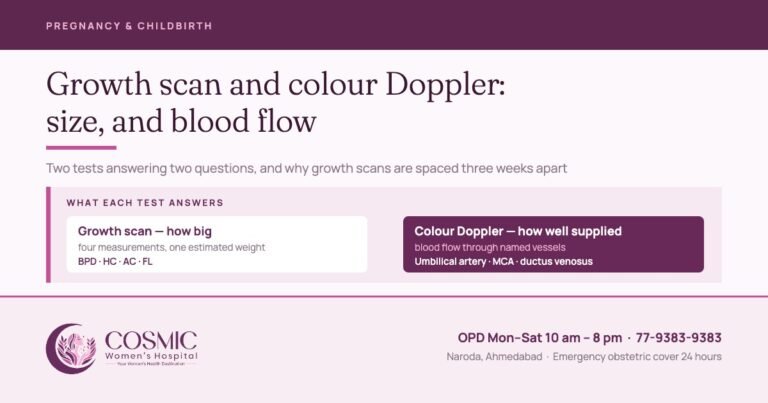
A baby measuring small is followed with serial growth scans and colour Doppler of the umbilical and middle cerebral arteries. Doppler is what separates a small baby who is simply small from one whose placenta is failing, and it is the finding that usually decides the timing of delivery.
Where the delivery happens matters
For a high-risk pregnancy, the questions worth asking any hospital are simple and specific: Is there an operating theatre and an anaesthetist available round the clock? Is blood available quickly? Is there a neonatal unit on the premises, and to what level? Who will actually attend the delivery?
Gujarat’s maternal mortality ratio is 53 per 100,000 live births against a national figure of 93 (SRS 2019–21) — the state has already met the 2030 Sustainable Development Goal target. Those numbers move because problems are picked up early and deliveries happen in the right place, not because complications became rarer.
Care at Cosmic Women’s Hospital
Cosmic Women’s Hospital & IVF Center in Naroda runs obstetric care, including high-risk obstetrics, alongside gynaecological surgery and a Level 2 registered ART unit. High-risk pregnancy, obstetric ultrasound and Doppler, and operative delivery are handled by Dr. Rahul Khatri (MBBS, MS & DNB Obgy, FMAS). The IVF programme is led by Dr. Bhargavi Khatri (MBBS, MS Obgy, Gold Medalist, FRM). If you conceived after fertility treatment, the two run together — you are not handed from one to the other at 12 weeks.
Related reading: Gynaecologist in Naroda · Recurrent miscarriage · Age and fertility
Book a consultation
Cosmic Women’s Hospital & IVF Center, 3rd Floor, The Capital Corporate, Nr. Naroda Muktidham, Naroda, Ahmedabad – 382330
OPD 10am to 8pm · 77-9383-9383 · contact@cosmichospital.in
Bring your previous discharge summaries, scan reports and blood reports to the first visit — a high-risk plan is built on what has happened before.
Please note: This page is general information about obstetric care and is not a substitute for consultation, examination or a diagnosis. Every pregnancy differs, and treatment decisions must be made by your own doctor after assessing you. No outcome is guaranteed in medical treatment. If you have symptoms, contact your obstetrician or attend the hospital rather than relying on anything written here.
Sources
- US Preventive Services Task Force. Aspirin Use to Prevent Preeclampsia and Related Morbidity and Mortality. Grade B recommendation, 2021. uspreventiveservicestaskforce.org
- Rolnik DL, Wright D, Poon LC, et al. Aspirin versus placebo in pregnancies at high risk for preterm preeclampsia (ASPRE). N Engl J Med. 2017;377(7):613–622.
- National Family Health Survey (NFHS-5), 2019–21 — anaemia in pregnant women aged 15–49: 52.2%. Ministry of Health and Family Welfare, Government of India. pib.gov.in
- National and regional prevalence of gestational diabetes mellitus in India: a systematic review and meta-analysis. BMC Public Health, 2024 (published 20 February 2024). Pooled prevalence 13% (95% CI 9–16), 117 studies; west zone 7%. bmcpublichealth.biomedcentral.com
- National Guidelines for Diagnosis & Management of Gestational Diabetes Mellitus. Maternal Health Division, Ministry of Health and Family Welfare, Government of India. nhm.gov.in
- National, regional, and global estimates of preterm birth in 2020, with trends from 2010: a systematic analysis. The Lancet, published 7 October 2023 (London School of Hygiene & Tropical Medicine with WHO and UNICEF). India 3.02 million preterm births, ~13% of live births. thelancet.com
- Romero R, et al. Vaginal progesterone for the prevention of preterm birth in women with a sonographic short cervix: updated individual patient data meta-analysis. American Journal of Obstetrics and Gynecology, 2025. Cervical length ≤25 mm; preterm birth <33 weeks RR 0.63 (95% CI 0.48–0.82), 4 trials, 966 women.
- WHO ACTION Trials Collaborators. Antenatal Dexamethasone for Early Preterm Birth in Low-Resource Countries. New England Journal of Medicine, published 23 October 2020. 2,852 women, 26–33 weeks, Bangladesh, India, Kenya, Nigeria, Pakistan. nejm.org
- American College of Obstetricians and Gynecologists. Practice Bulletin No. 205: Vaginal Birth After Cesarean Delivery. 2019. Reported VBAC rates 60–80% with trial of labour.
- Sample Registration System (SRS) Special Bulletin on Maternal Mortality, 2019–21. Registrar General of India. India 93, Gujarat 53 per 100,000 live births. pib.gov.in
- Press Information Bureau, Ministry of Health and Family Welfare. Update on Pradhan Mantri Surakshit Matritva Abhiyan (PMSMA), 2 August 2024; National Health Mission Gujarat, Maternal Health.
- Ministry of Health and Family Welfare, Maternal Health Division. Pradhan Mantri Surakshit Matritva Abhiyan — guidelines; pmsma.mohfw.gov.in.
- Ministry of Health and Family Welfare. Guidance Note: Extended PMSMA for tracking High Risk Pregnancies, 2022; Press Information Bureau, Nine years of PMSMA, June 2025.
- Ministry of Health and Family Welfare. Anemia Mukt Bharat — Intensified National Iron Plus Initiative, Operational Guidelines, 2018.
Written by Dr. Rahul Khatri
MBBS, MS & DNB Obgy, FMAS — Consulting Obstetrician-Gynaecologist and Laparoscopic Surgeon
Director, Cosmic Women’s Hospital & IVF Center, Naroda, Ahmedabad
Medically reviewed by Dr. Bhargavi Khatri
MBBS, MS Obgy (Gold Medalist), FRM — Consulting Obgyn, Infertility & IVF Specialist
Published 4 September 2026. Next review September 2027. This article is general information about medical conditions and treatments. It is not a diagnosis and is not a substitute for consultation with a qualified doctor who has examined you and seen your reports.
Book a consultation
Tell us how we can help and we will call you back.

Cosmic Women's Hospital
Cosmic Women’s Hospital & IVF Center is a registered Level 2 ART clinic in Naroda, Ahmedabad — obstetrics, gynaecological surgery, IVF and ICSI, with ultrasound in-house and 24-hour emergency obstetric cover. Articles here are written by the clinical team and medically reviewed by Dr. Rahul Khatri or Dr. Bhargavi Khatri before publication.